A Tour of Gardenwoods
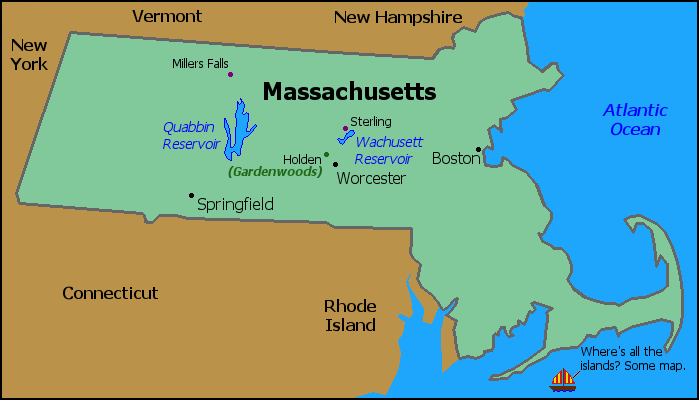
A Personal Map of Massachusetts, Showing Some Locations Mentioned in the Text
Introduction
[24 May 2020] I started this site celebrating the gardens and woods around my house with pictures and small stories. I hope to update the site occasionally as the year goes on.
[30 May 2020] More plants have come into bloom, with the spirea being amazing.
[06 June 2020] Things change rapidly this time of year, especially once the weather has gone from cooler-than-usual May into warmer-than-usual early June. The highlights are the Secret Azalea, peonies, and a bearded iris.
[13 June 2020] Just as the spirea fades, the mountain laurels and mock orange start to bloom.
[20 June 2020] The peonies are ending their bloom. The weather has gotten warm enough at night for the bougainvilleas to leave the house. The impatiens are not doing well. Of the four I got, two failed and a third is withering. Perhaps the impatiens are not resistant to the blight, or perhaps I planted them too early, as the night weather got into the 40s a few days after planting. I'll watch how the last one fares and either get new ones if it does well or get something else.
[27 June 2020] A new flood of flowers are out, including roses, daylilies, snapdragons, sundrops, one astilbe ... and Mystery Flowers. I've finally gotten a long, soaking rain that will greatly help water the plants. The threat of drought is not over but at least postponed.
[05 July 2020] June 27th started five days of occasional rain and cloudy weather than kept the sun from drying out the plants. The gardens got a very needed soaking and are growing great. The front garden, with its hostas and lady's mantle, no longer looks like a salad. The rainy weather wasn't enough to get the stream flowing again, indicating that the soil will dry out quickly if we get another run of hot, sunny, dry days.
[11 July 2020] Two cultivated flowers, gooseneck loosestrife and moonbeam coreopsis, as well as two wildflowers, rose campion and yellow wood sorrel, have started their bloom.
[18 July 2020] Hybrid daylilies and hydrangeas (pink and blue side by side) are the headliners this week. Opening acts include a fruiting mayapples, flowering nasturtiums, the so-called fairy rose, and a finally recovering morning glory.
[25 July 2020] Monardas are blooming, and hummingbirds are visiting them. The daylilies continue to ramp up their blooming. Alas, the second batch of impatiens have dropped all their flowers and are starting to look unhealth. The first batch is totally gone. There goes my hope that the nurseries were selling a disease- or fungus-resistant variety. No more impatiens for me!
[01 Aug. 2020] This week it's more flowering hostas and daylilies. I can now confirm that I have wildflower black-eyed Susans and also suspect I have wildflower broad-leaved helleborines, sometimes known as the weed of the orchid family.
[08 Aug. 2020] It is time to tell a tale of two nettles in the front gardens. Out back, black-eyed Susans are not only out in large numbers but are visiting their cousins, the gloriosa daisies.
[15 Aug. 2020] A parasitic wildflower, more flowering hostas, and perennial sunflowers are the stars of this week.
On the night of 14 August, the heat wave we've been having finally broke, with cooler, cloudy weather but no significant rain. All of Massachusetts is now in Level 2 "Significant Drought" with below average rainfall for over three months. Many plants in some gardens were looking bad, so I did emergency watering early in the morning, which helped a lot. However, the drought is causing less blooming than usual. Most daylilies are already giving up blooming, for example, and the perennial sunflowers are about two feet shorter than usual. A week ago, the butterfly bush was just starting to bloom, but now it looks like it may not bloom more. Many of the orange touch-me-nots have died back as the soils dries out, although at least one is starting to bloom. Also a tropical storm blew through the area on 4 August with little rain but gusts of wind. This flattened a number of plants, which haven't gone upright yet and may not for the rest of this year. The Japanese andromeda, which was here since we got the house, has been looking bad for months and finally all the leaves are brown. I had been hoping to take pictures of it when it bloomed.
[22 Aug. 2020] A couple of slightly unusual flowers make their debut: coneless coneflowers (yes, really), and what seems to be double-blossom phlox.
Over the past week, I've used a small bit of my stimulus check to renew my hosta hacienda (not pictured). Several years ago, I hired a contractor to repair a leak in the water pipe running up to my house. I got a fixed price, but the contractor had great difficulty actually locating the leak, and a one day project ran for two and half days. I thought he was going to ask for more money, but instead he wrecked, deliberately I think, part of my yard. He had pulled up the lamp posts and laid them on the ground but then managed to break almost all the glass in them. Worse, all my hostas within six feet of the driveway were destroyed, some just dug up and discarded, others covered in debris. All the giant blues, that were there when I got the house, were lost, as were all my miniatures and more. Maybe half my hostas perished in the hostageddon. Despite promising to return and fix up the yard, he never came back. Calls just went to the person who answered the phone, who eventually admitted the contractor knew about the yard but had no idea if the contractor would come back to fix things. I finally realized what was going on and moved on.
Anyway, eight new hostas went in, mostly in new places, since the soil along the edge of the driveway got degraded, with lots of gravel mixed in it. I got one big blue, which went where the defunct Japanese andromeda used to be. If it does well, it may eventually grow to be three feet tall and five-to-six feet wide. I also got several medium and large hostas with gold-and-green and white-and-green variegated leaves. The gold-and-greens are striking and come in two basic plans: gold on the leaf edges with green in the center, and the other way about, green on the leaf edges with gold in the center. I got both types. Finally, I got two miniature hostas, which I used to fill gaps in the gardens.
Several hostas went into Emilie's Garden. However, the top soil is not very deep there and has a lot of sand underneath. Hostas like moist soil with lots of organic matter (like good compost). I'm going to try to build up the soil there. I spread a lot of peat moss around to try to improve moisture retention, and I guess I'll start mining the compost pile again for the organics.
The last two hostas went into the Shade Garden, joining the three already there. To make room, I dug up a dozen daylilies there, as this garden is far too shady for daylilies, and transplanted them into the sunnier part of Emilie's Garden, expanding the large planting of daylilies already there.
[30 Aug. 2020] The orange touch-me-nots are in flower, as are the white woodland asters.
The weather has cooled down into very comfortable days, and a couple bouts of rain have taken the edge off the drought. I've written a lot about the drought in these entries because it has reduced the growth and flowering that I get in a normal year. However, the drought is only moderate, and I've been through a severe drought or two with much more devastating effects. My hill of ferns is 99% green, with only a few ferns turning brown. One drought, all the ferns had just given up and died off by this time. This year, I'm projecting brown-out will occur in September unless we get more rain soon (only a little is forecast for the next seven days). In a good year, the ferns can stay green well into October. While its looks like they're gone forever when they go brown early, it actually doesn't seem to hurt them. Next year they come up right on schedule. Since the ferns are perennial, I figure lack of water induces the plant to shut down the foliage early to save food for the roots.
[5 Sept. 2020] Iron Urn 2, the sequel to Iron Urn is now playing. See how our superhero came back from the gates of doom. Rated PG. Also, the sequel to May's Lilies of the Valley in Bloom, Lilies of the Valley in Berry has been released. Rated G.
[12 Sept. 2020] Yet another mystery wildflower is unmasked: goldenrod! I was wondering if my obedient plants were not going to bloom because of the drought, but they are doing fine. A big surprise is that weeks after my daylily season ended early, a stella d'oro is blooming! The final entry goes beyond Gardenwoods, to show some closed gentians in bloom at Wachusett Meadows, the Audubon sanctuary in Princeton.
[20 Sept. 2020] Lots to see this week:
- More obedient plants in bloom.
- Boltonia is in flower.
- Phlox is blooming in the Sunken Garden.
- Smartweed, likely lady's thumb, is in display.
- Cold weather has forced the house plants to end their outside summer vacation.
- Yet a new mystery! Why is there a ladder and strange box in conservation land in Princeton?
[27 Sept. 2020] I have several plants that have buds and want to flower, but the drought and the recent cold are making things difficult. It has warmed up nicely the last three days, so just maybe soon you'll get to see pictures of flowering morning glory, portulaca, and pink turtlehead. My mock orange also usually blooms in September (after its first blooming in the spring. It did form many new green buds in August, but as the drought continued into September, most if not all buds turned a dead brown, so I'm not hopeful. The good news, however, is that I have happily-blooming chickweed (or stitchwort or starwort...) and a third or fourth blooming of the fairy rose.
[3 Oct. 2020] The pink turtlehead finally is blooming. The morning glory and portulaca are still trying, but the mock orange has given up and its leaves are turning yellow. Out and about, the invasive Japanese knotweed ("Japanese bamboo") is blooming around town, and I made a trip to Stillwater Farm.
[10 Oct. 2020] The morning glory has bloomed at last! Autumn color is also here in Holden, and I saw some great purple-and-yellow asters while hiking by Wachusett Reservoir.
[17 Oct. 2020] A hosta has decided to bloom in October. Most of my broad-leaved helleborines are gone, but the pair in the Side Garden are still up and little changed from August. In the wider world, I finally spotted some yellow hawkweed, a wildflower that is usually prolific around here most years.
[24 Oct. 2020] Animal vandals, a Story about the Birds and the Bears, is a tell-all account about the animal vandals that have been attacking my house, stealing suet, and bending bird feeding gear.
new![1 Nov. 2020] Snow on 30 October. More snow predicted. Woolly mammoths and glaciers rumored to be advancing south from the frozen north.
newest![8 Nov. 2020] It was cold with snow flurries through 3 November, and the flowers took a big hit. Then it warmed up and is now unseasonably warm and pleasant, with daytime temperatures in the 60s and even 70s. The snapdragons, which did not do well this year, survived the best, with some still in bloom. Some of the petunias look like they might reflower if it stays mild longer. The blue lobelia, which I thought would weather the cold the best, are struggling, although one might just come back. Everything else, however, is done for the year.
There's really no good pictures to take from the yard, so instead here's a beaver dam at Muddy Pond that I photoed in late October.
By the way, I use my own writing style, a mix of American, British, and other practices that I think work well. If you notice anything odd, it's probably quoted material, as I put commas and periods outside the quotes where they belong rather than tucked inside.
The Approach
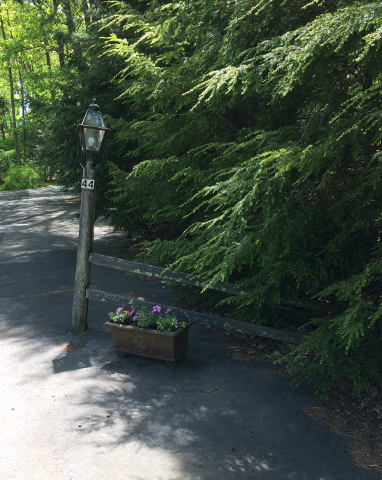
The Approach
[24 May 2020] Emilie got the iron planter at Brimfield (outdoor antiques show in Central Mass.). It's far heavier than it looks!
Where's the house? You can't see it from the street.
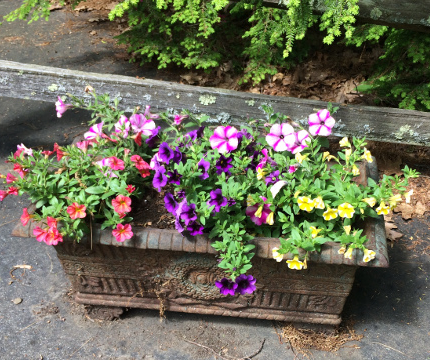
I am Iron Urn
[06 June 2020] The flowers in the iron planter are coming along fine.
I am Iron Urn
It was turned to steel
In the great magnetic field
Where it traveled time
For the flowers of plantkind
Now the time is here
For Iron Urn to spread cheer
Blossoms we all crave
Make us dance and rave
[06 June 2020] This is the Secret Azalea. We owned the house for years and years before we noticed this bush blooming one spring. It is tucked away on the side of the driveway under hemlocks and mountain laurel and is quite unnoticeable except when its blooms. I once thought of moving it to a better location, but it always blooms every year, whereas a pink azalea I bought and planted as a specimen in a great spot never thrived and then gave up. Some things are just best left alone.
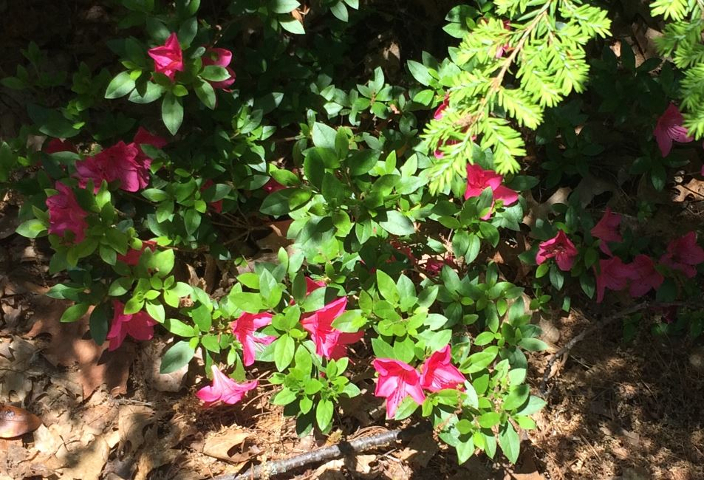
The Secret Azalea
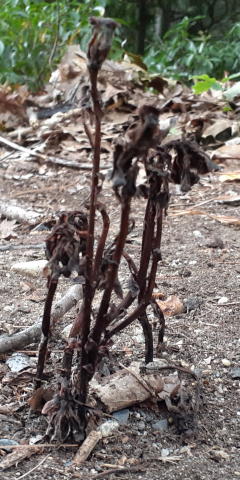
[15 Aug. 2020] This is not a fungus. This is not a withered plant done in by the heat and drought. This is not some alien lifeform trying to wrap around your ankle, take over your nervous system, and start the invasion to replace humanity with pod people.
OK, now we know what it is not. So, what is it? I dunno.
But I can make a good guess. It is some sort of parasitic plant, a wildflower burst forth in full bloom from its underground domain. It's purple-red color with no green strongly suggests it is one of the many, mostly unnoticed flowers that lack the chlorophyll which makes most plants green. Without chlorophyll, it cannot make its own food. Chlorophyll uses the energy from sunshine to turn carbon dioxide and water into sugar and oxygen. The sugar feeds the plant, and the oxygen is dumped into the air or water.
These parasite plants feed off other plants, either directly via glomming onto their roots, or indirectly, from tricking the mycorrhizal fungus that works with the roots of regular plants. The fungus and roots are in a symbiotic relationship where the roots get nutrients and water from the fungus, which in turn gets sugar from the plant. The parasites steal some of this sugar from the fungus. These parasites live underground since they don't need sunlight, but when they are ready to bloom they grow "stems" (really more like modified roots) above ground with their flowers. And, yes, the flowers are real flowers, and you can even see bees visiting them if you are lucky. They are not mushrooms, toadstools, or any other type of fungus at all.
By the way, I call them parasite plants because that is what they are, not as a value judgment against them. After all, you are dependent upon plants, too. Unless you are a scientist, almost all animals you're familiar with directly or indirectly depend upon plants for food. Even carnivores that only eat meat ultimately get their meat from a plant-eating animal. (Just don't bother to tell your mouse-munching, vegetable-hating cat about this; like almost everything else you say to them other than "dinner time" they will either ignore it or not believe it.)
Pop Quiz!
Q1: Can you name an animal that doesn't directly or indirectly depend on plants for food?
A1: Giant tube worms live deep in oceans around hydrothermal vents. Bacteria living in the worms convert the chemicals released by the vents into food for the worms. No food from plants, even indirectly.
Q2: So the worms are completely independent of plants?
A2: No. The worms still need oxygen like other animals. They get their oxygen from the seawater, not from the vents, and this oxygen comes mostly from sea plants (especially algae) and a little bit from cyanobacteria. While cyanobacteria are sometimes called blue-green algae, they are not really algae or plants at all (hence the bacteria part of "cyanobacteria"; in case you are wondering, the "cyano" part means "blue-green"). If all the plants suddenly disappeared, the worms would be in trouble unless the cyanobacteria could put in a huge growth spurt and pump out more oxygen.
So, I have a parasitic wildflower. I can make an even better guess at what it is: it's likely dutchman's pipes or possibly indian pipes. Indian pipes (Monotropa uniflora, also known as ghost plant, ghost pipes, and other names) is a parasitic plant that is fairly common around here. Indian pipes are usually waxy-white but can be pink or, rarely, deep red. I at first thought this was what I've got, since in some years I do get the white indian pipes. However, I noticed the double flowers on one of the stems. Indian pipes are supposed to have only one flower per stem. Dutchman's pipes (Monotropa hypopitys, also known as pinesap, false beech-drops, and other names) is similar to indian pipes but can have multiple flowers per stem. Its color can range from yellowish-white to yellow, orange-ish, and light red, sometimes with several of these colors at once. I've not heard of it being purple-dark red, but that's what I've got. Dutchman's pipes prefer the roots of pine trees (hence the alternate name pinesap) but will grow elsewhere. My flower is growing under an oak tree, but there are some pine trees not too far away.
Of course, it's possible that the flower could be some other parasitic plant. Besides the thousand or so common wildflowers you can find in a good field guide (almost 1,300 in Peterson's, for example), there many thousands more wildflowers that are much less common or are restricted to a very small range. If you have a field guide handy, just look at the section on violets: there's lots of species there, plus many more that didn't make the book.
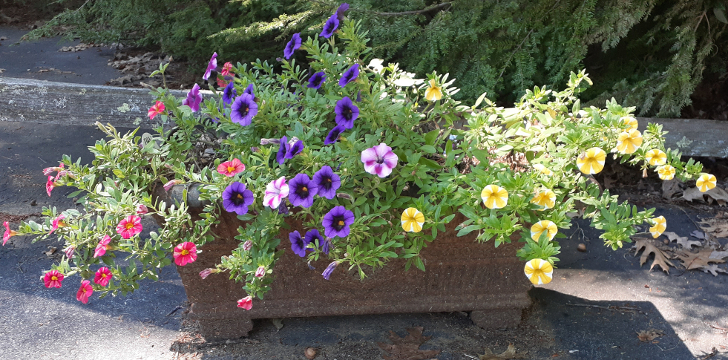
Iron Urn 2
[5 Sept. 2020] Iron Urn looked like it was going down and out a few weeks ago due to the drought and a heat wave. All the flowers had dropped off and the leaves were very limp. Emergency watering kept it on life support, until the weather cooled and we go some rain. This week, it looks like nothing had happened to it!
The Long View
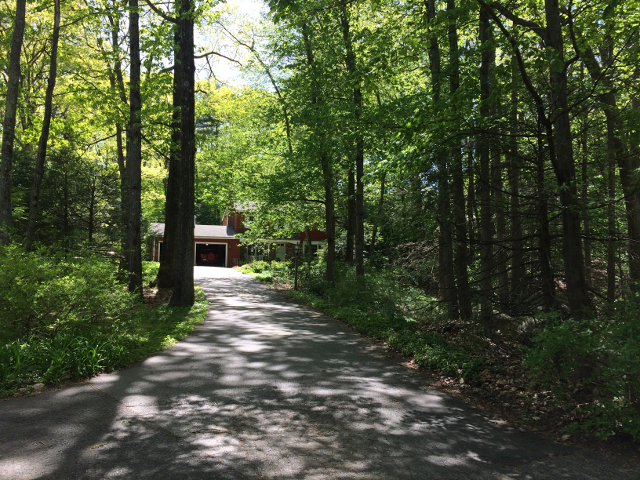
[24 May 2020] There's the house! There's also maybe a dozen chipmunks or so running around, but they're too small to see. I had a bumper crop of acorns last fall, and this year the chipmunk population has soared.
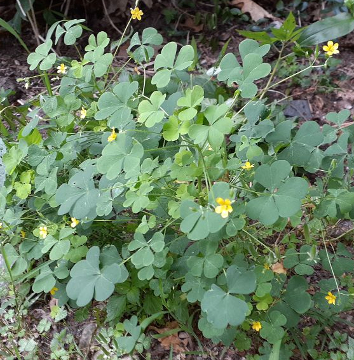
[11 July 2020] Yellow wood sorrel loves to grow along the edge of the driveway. It is a very common wildflower and accordingly has many common names including yellow oxalis (and it is an oxalis), lemon clover (it is not a clover), yellow sorrel (it is not a true sorrel), and sourgrass (it is not a grass but is sour). There are many kinds of wood sorrels, most or all of which have a sour taste reminiscent of the true sorrel, a herb often grown as a salad plant. Many oxalis species are also called and some sold as "shamrock plants" because their leaves look like classic shamrock leaves. Most of these false shamrocks have three leaves just like real shamrocks (clovers). There's even one oxalis species that looks like a four-leafed clover, although with some purple but no luck in its leaves.
By the way, Oxalis is also the scientific name for the genus of these plants. It is derived from the Greek word meaning "sour" or "acid".
The Island Garden
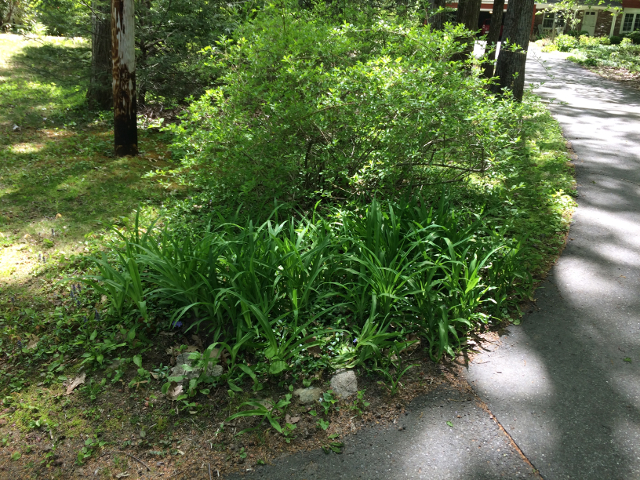
[24 May 2020] I call this spot the Island Garden, as it is wedged into a narrow strip of land between my driveway and the next door house's property, which starts at the telephone pole. Orange daylilies are growing in foreground, with forsythia in the back. This time of year, late May, many of the gardens have finished their spring bloom (the forsythias just dropped their yellow flowers) but have not begun their summer bloom (daylilies will start blooming perhaps in a month).
The Side Stream
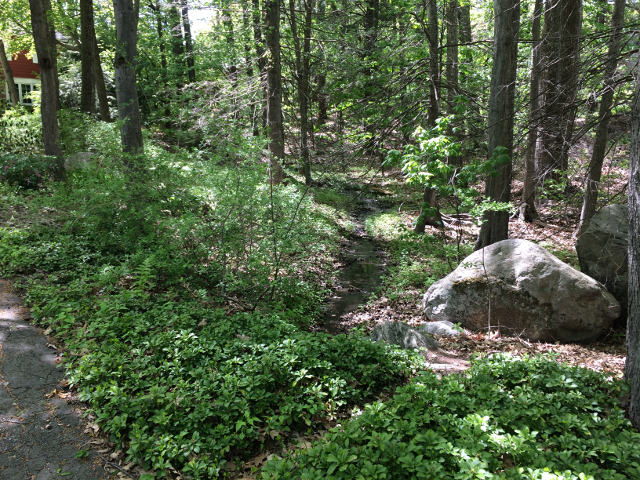
[24 May 2020] This small stream usually flows most of the year but dries up in summer's heat of July and August except in very wet years. It's hard to see, but there's a large winterberry where the stream disappears into a culvert to flow under the driveway. Winterberries love wet locations and grow abundant small red berries in the fall that birds eat through the winter. It's not quite wet enough here for winterberry, so the berry crop is almost always small.
[06 June 2020] The stream is already drying up. There's no running water, just mud. This is a month sooner than usual, signaling the spring has been drier than usual.
The Path by the Stream
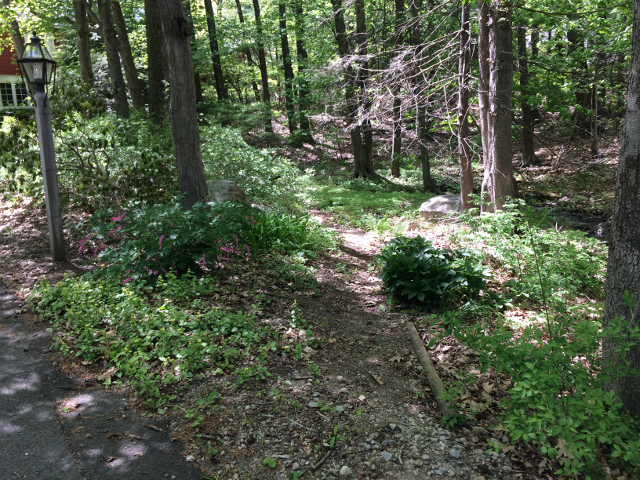
[24 May 2020] On the left are lamium, which have naturalized into this area, backed by a bleeding heart. The dark green clump on the right are Lenten roses.
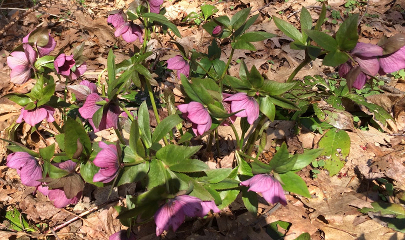
Lenten roses while in bloom from a few weeks ago
The Lenten roses are a gift from Lisa. They began blooming in March and have just ended. Their common name comes from the fact that they are almost always in bloom during Lent. Amazingly, the Lenten roses have begun growing in a new stand several feet further down the path. For a very long time, they only grew where they were planted, and I never suspected they could naturalize or reseed around here, but they can!
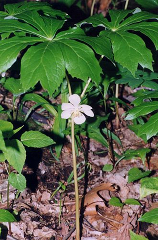
Mayapple in bloom
(picture from the Internet)
Further in, hard to see, are mayapples. We used to see them growing wild in the woods in Massachusetts in May and June. One year, Garden in the Woods, a fantastic botanical garden in Framingham, had them for sale. They were expensive but we got one, and it liked growing by the path and spread. Some years a dozen or more grow, although recently only two or three come up.
The name "mayapple" comes from the fact that in many places the flowers come out in May (sometimes April) and looks like an apple blossom. They are not blooming in my yard yet, and, around here, I often see them blooming in June. If they do bloom later, I'll take a picture.
Some people claim that the "apple" part of the name "mayapple" refers to the fact that the flowers develop in the summer into light green fruits that vaguely look like apples. The emphasis is on "vaguely": they look like apples if you're not too picky about their color (way too pale for a green apple), shape (more like an onion bulb than an apple), and location (on a small plant, not a tree). Maybe the person who came up with this derivation first ate one or another part of the plant. Almost the entire plant is toxic to some degree, although in small amounts parts have been used as a purgative. The ripe fruit is edible raw in small amounts and its juice can be cooked and made into safe-to-eat mayapple jelly.
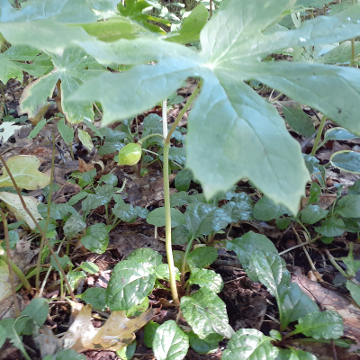
[18 July 2020] I missed the blooming of my mayapples! I didn't check them every week in June, so maybe they bloomed then, or maybe they pulled a fast one on me and bloomed in early May despite my claims that they don't do this here. Anyway, the picture shows one of my mayapples with the fruit developing where the flower must have been.
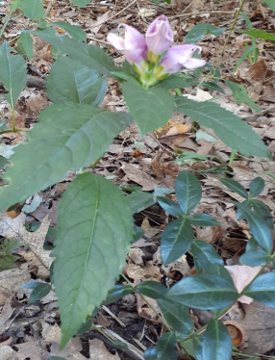
[3 Oct. 2020] The pink turtleheads are blooming. Turtleheads are shade plants that prefer moist conditions, so because of the drought my four specimens are not as big and bushy as the usually are, but all managed to bloom anyway.
Emilie's Garden, Lower Entrance
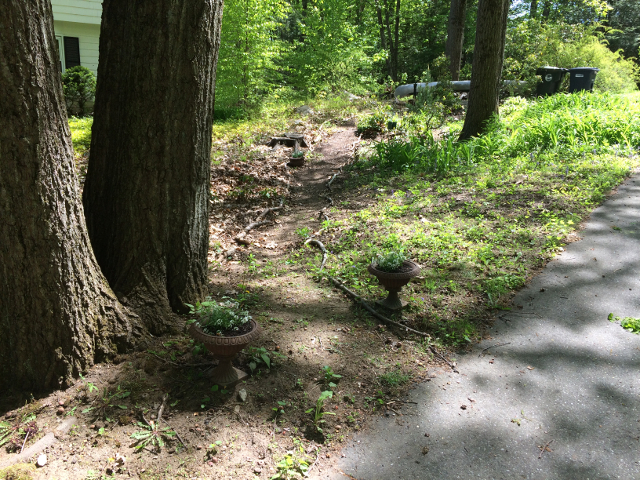
[24 May 2020] Emilie and I started this garden just a few years ago. There used to be a large hemlock tree here shading everything, but it failed, likely a victim of the insect pest wooly adelgids, and was cut down. We started a new garden here with a Swiss stone pine, adding a daffodil bed and daylily plantings. I've recently expanded the garden, laying down a path (yet to be mulched in) and adding urns and planters. To the right of the path's start were supposed to be wildflowers growing from seed, but it's unclear if anything is coming up yet. It's been a cool April and May, so there's still hope they might come up.
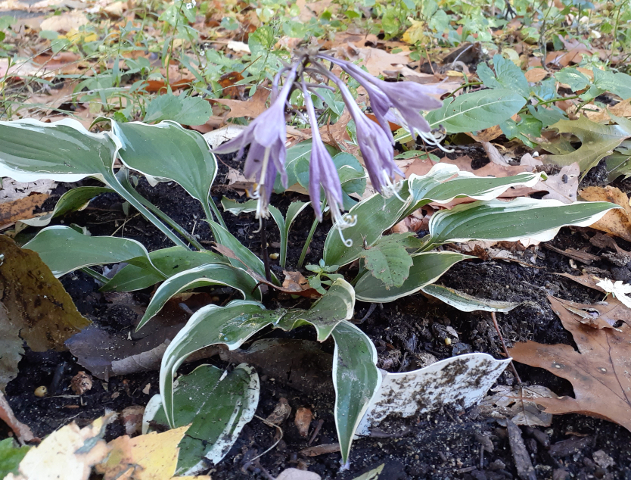
[17 Oct. 2020] Last August I planted eight hostas to start rebuilding my heavenly hosta host. One hosta did great for two weeks and then disappeared over two days. Chipmunks had dug a hole under it the first day, damaging the hosta badly, and then dug another hole under it the next day, obliterating it. I've left the plant stake in the ground so I can find its position next spring. I'm hoping some of the roots survived and might regrow the plant. The rest of the new hostas are fine and are doing what transplanted hosta do best: just sitting there regrowing their roots for next year. Except this one in the picture, it decided to use some of its food supply to flower in October.
Emilie's Garden, Center
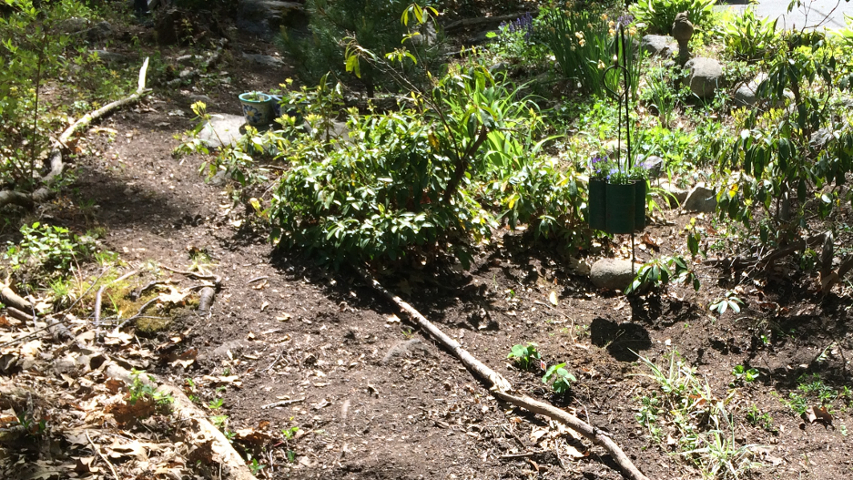
[24 May 2020] Emilie got the hanging planter at Brimfield. It looks like someone got three old-style bait cans, welded them together with a hanger, and painted them dark green. They're just the right size for blue garden lobelia (Lobelia erinus). In front on the ground are nasturtiums. They are supposed to like poor soil, so they should love it there! We'll see...
The pots in the upper left are marigolds. We used to grow a lot of marigolds in the Back Garden, but then a plant disease or fungus began attacking them every year until we could grow them no more. I suspect the disease is established in the soil out back, so I'm trying marigolds here in pots with a mix of garden soil from a store and peat moss.
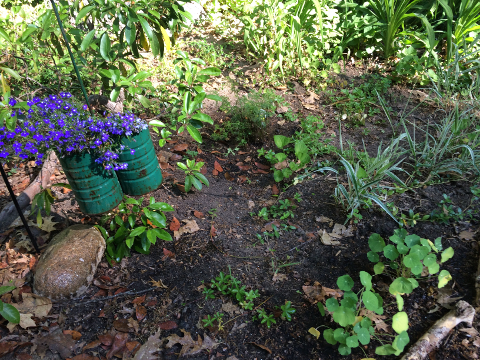
[20 June 2020] The blue lobelia are doing great in the Hanging Cans of Babylon, as I hoped they would. It's been very dry with little rain for weeks, so I need to remember to water them. On the ground floor, the nasturtiums have greatly increased in size. Since the nasturtiums seem to like it here, I added another poor-soil tolerant plant, coreopsis. It is in the picture in the back but you probably can't make it out because of the shade. If it does well and blooms, I'll give it another photo op later. Coreopsis is also called tickseed, not because it attracts ticks but because some people thought its seeds looked like ticks. Then, what about all those other plants that also have little black seeds? Why aren't they called tickseeds, too?
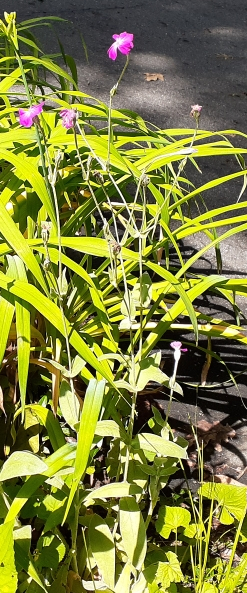
[11 July 2020] Rose campion is growing wild next to the daylilies. You can see the campion's stalks and leaves are a very different shade of green that the bright green of the nearby daylily and violet leaves. It's a bit like the silvery-green of a dusty miller, although I think the resemblance is better when the campion first comes up and only has a basal clump of leaves.
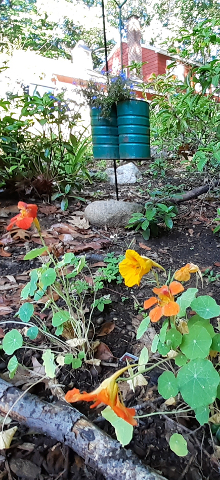
[11 July 2020] The nasturtiums are blooming in a range of orange colors from yellowish to reddish. If all goes well from now till next spring, I hope to fill in the area with more nasturtiums.
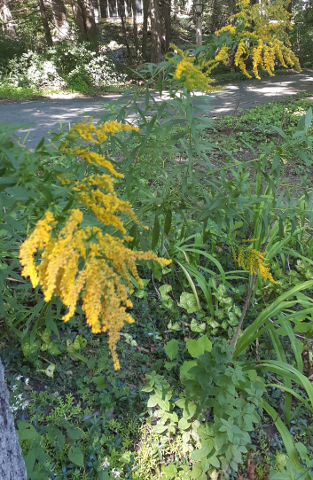
[12 Sept. 2020] I've been watching this wildflower grow for months, wondering what it was. I had five stands of it growing in various places. The stems were getting four to seven feet tall, with leaves that could indicate many different types of plants. I wondered if they were some kind of asters, but then they bloomed into goldenrods. Goldenrods are great late summer and autumn flowers. There's at least 100 different species of goldenrods (a few which have white flowers rather than yellow), so I'm not going to try to identify which species I have. Goldenrods varying in how their flowers are arranged. The one I have has a pyramidal cluster of flowers (the pyramid on the left in the picture is upside down as the stem is bending over from the weight of the flowers), a very common type I've seen in New England and the Midwest. Other common types are flat-topped clusters, linear, often arched "sprays" of flowers, and cylindrical "clubs" of flowers. There's even some woodland "axillary" types with the flowers growing on the stems at the leaf junctions.
When I was a child, people used to blame goldenrod for the late summer/autumn "hay fever" season, which can be a real bane for allergy sufferers like me. Goldenrod is innocent! Goldenrod flowers are pollinated by insects, so very little goldenrod pollen gets blown around. Goldenrod is very distinctive and happens to bloom about the same time as the autumn allergy season, so it unjustly got blamed. The real culprits are autumn wind-pollinated flowers, which release vast quantities of pollen to blow around everywhere. The most likely villain is the common ragweed (also called American wormwood and other names), which blooms in late summer and autumn. This weedy plant is easy to overlook even in bloom, as it has small green flowers that don't look like much.
Emilie's Garden, Upper Entrance
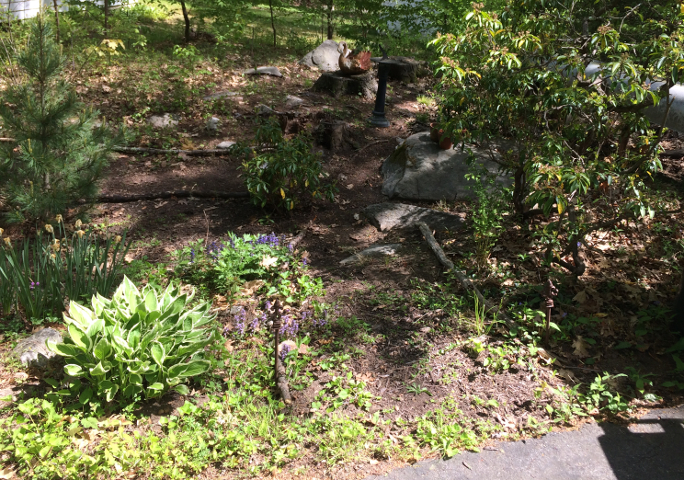
[24 May 2020] Things are a bit hard to make out, other than the hosta in the front, the spent daffodils in the left center, and stone pine in the back. There's more pots of marigolds on the right. The black "post" in the back is a sundial, set to daylight savings time and correct to within 15 minutes or less. Brimfield is represented by the pair of iron fleurs-de-lis at the start of the path and the rusty-white iron swan in the back. The swan is a planter and somewhat heavy.
There's another swan elsewhere as well as a rusty astrolabe-like thing and a massively heavy cast iron birdbath plus other stuff. Antique show? I'm going to call Brimfield the scrap metal show from now on!
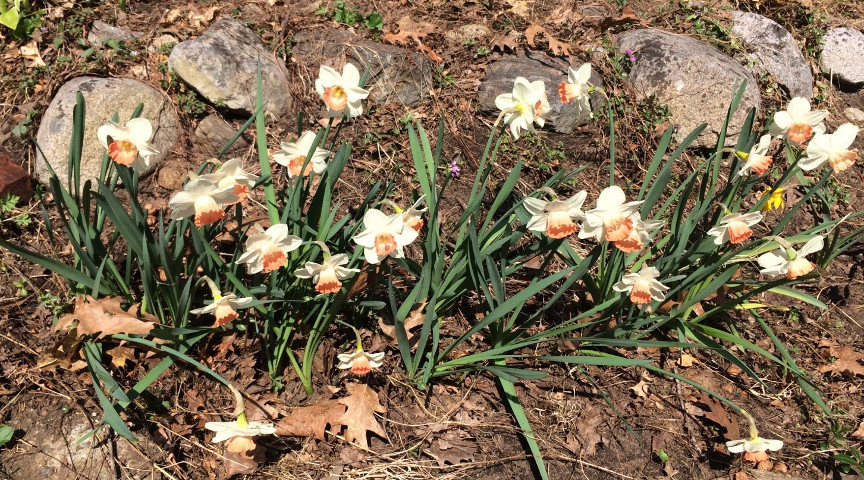
Daffodils in bloom from a few weeks ago
[30 May 2020] What a difference one week makes! Last week, the spirea was just a twiggy green-leafed bush next to Emilie's Garden. This week it is in full bloom.
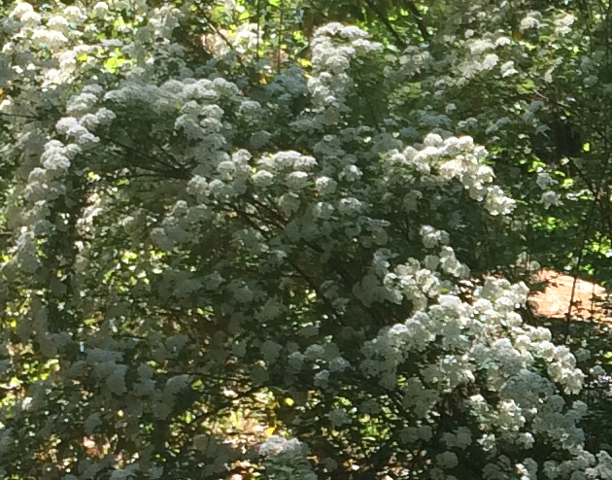
Spirea
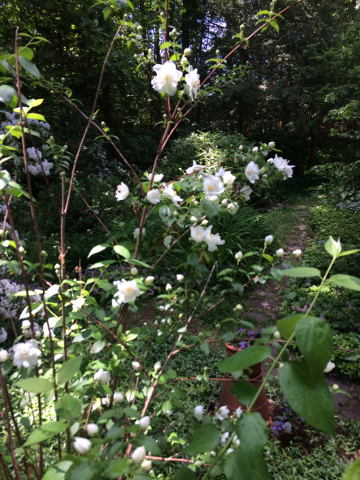
Mock Orange
[13 June 2020] To the right of the now-faded spirea, the mock orange has now come into bloom. We planted the mock orange a long time ago, and it grew and bloomed great. It often bloomed twice in a year; once in May or June and then again in September. Until about 5-7 years ago. It then got some plant disease or fungus that caused the leaves to grow small and crooked. They weren't producing enough food for the plant, which caused entire stalks to die off. With nothing to lose, I began a radical pruning program, cutting off at the base every stalk that had bad leaves soon after the first bloom and making sure no bad leaves were left near the plant (just in case the disease/fungus overwintered in the dead leaves and reinfected the plant the next spring). The plant put up new shoots to replace the cut stalks, but in the first years of Operation Mock Prune some of the new shoots got bad leaves. However, I persisted, and the last 2-3 years the mock orange has come back with all-good leaves and great blooms.
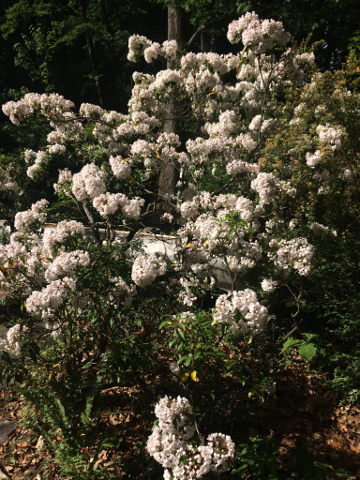
Mountain Laurel
To the left of the spirea, and throughout the yard, the mountain laurels are now in bloom. These bushes grow wild around here, and we have maybe a dozen or more. They like to grow in part shade along the margins of the woods and open spaces, which means I have them along the driveway, on each side of the house, and on the hill that climbs from the back yard to the woods.
Mountain laurel can get quite gangly over time, as new leaves and branches usually grow from older wood, which then often drop their leaves. Also, new growth on a branch usually starts with about five twigs with leaves, but over time most of the twigs die off, leaving only one or two that retain leaves and hardened into wood. So, you get long, twisted, grayish branches with only a few leaves at the end. Maybe they're good for thrilling kids at Halloween with stories of moving evil bushes trying to clutch people, but the rest of the year they look ugly. What can be done about this? The solution again is radical pruning. Cut off a gnarly branch close to the base of the bush. Cut off all the gnarly branches. Use strong, sharp cutters or a good saw, as mountain laurel wood is very tough. The next year, the plant will usually sprout new shoots from the base and within a couple more years will be a great-looking bush again. Be aware, however, that pruning can fail to revive very gangly, almost-leafless mountain laurels.
As a child growing up in northwestern Massachusetts, I enjoyed the tremendous displays of mountain laurel every spring. Northwestern Massachusetts is quite wooded and hilly in just the way mountain laurel likes, as the bush is all over the place. Entire hillsides can turn white during bloom time. One great place to see it was and hopefully still is the aptly-name Laurel Lake in Erving.
As an older child, I used to wonder if mountain laurel had some connection with the laurel wreaths of ancient times. The Greeks gave laurel wreaths to winners at the Pythian Games, which were dedicated to the god Apollo. Apollo had been enamored with the nymph Daphne and pursued her, but she despised him and called upon her father Peneus, a river god, for help. He turned her into a bay laurel tree, and thereafter Apollo honored Daphne by wearing a laurel wreath and making the laurel "immortal", as symbolized by its evergreen leaves. (In case you are wondering, the Pythian Games were not the Olympic games. Winners of the Olympic Games received olive wreaths made from the wild olive tree.) The Romans later adopted the laurel wreath to honor victorious generals in their triumphs. The Greeks also used leaves from the bay laurel to flavor their food, so the next time you find a bay leaf in a Mediterranean-style dish, you are participating in a culinary tradition that goes back thousands of years. Alas, the mountain laurel has no connection to the bay laurel. It does have evergreen leaves that somewhat resemble bay laurel leaves, which I guess is why it got called a mountain "laurel".
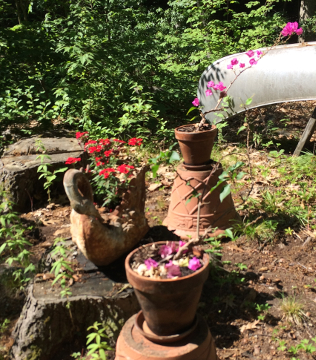
[20 June 2020] The two bougainvillea have come out for the summer. They are tropical plants that can't handle chilly weather. Supposedly they're OK down to 50 degrees, but I've found its best for them to bring them in whenever the night temperature is forecast to drop below 55. The other house plants (not pictured) are also out, two angel-wing begonias (which can't go in sunny spots) and a fern, very likely a Boston fern. It looks like a Boston fern but it hasn't spoken for ages, so I'm unsure of its accent. It usually grows great outside, and I'll take a picture of it if it does.
Emilie and I bought the bougainvilleas maybe 10 years ago at Logee's Greenhouses in Danielson, CT. Logee's is a very special place with many rare and tropical plants. Bougainvillea consists of a group of related species of vines, bushes, and trees native to South America. Wait! You thought they came from the South Pacific island of Bougainville? I did too, but it turns out the plants and island have nothing to do with one another except being named after Louis Antoine de Bougainville, who led France's first circumnavigation of the world in 1766-1769. Our bougainvilleas, also called lesser bougainvillea and paperflower, are the species Bougainvillea glabra, which means "bald bougainvillea". They go dormant and drop most or almost all of their leaves during their "dry season", which at my house means winter, even though they get watered as well as the begonias and fern. However, these annoying sticks (as that what they mostly look like for well over half the year) then start to flower with amazing magenta, paper-thin flowers. So now I have these nearly-leafless sticks with flowers all over them. Once they go outside, they will quickly drop all their flowers but soon grow lots of leaves, and they usually won't flower again until next winter when they've turned back to sticks.
Also in the picture is Redcakes, a classic red geranium in the swan planter. Its nickname comes from the fact that I associate geranium with uranium. The first processing stage for uranium after it's been mined creates yellowcake, a yellow uranium powder that with further processing can be turned into fuel for fission reactors. Redcakes on the other hand needs no processing except water if it continues to be as dry here as it has recently been.
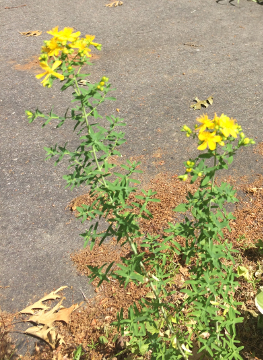
[27 June 2020] Mystery Flowers are blooming!
This is a wildflower that grows around here. It looks similar to Common St. John's Wort, but not as shrubby. St. John's Wort is in the genus Hypericum, which contains hundreds of species, most or all of which can be called St. John's Wort. I guess my Mystery Flowers are some kind of Hypericum. Since they are blooming in late June, just as Common St. John's Wort does, they may even be that.
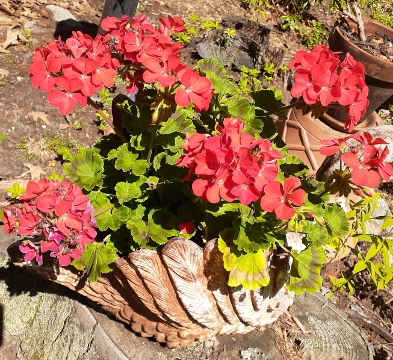
[05 July 2020] Redcakes is coming along fine and gets its closeup shot. If you look at its leaves, you see the classic purple-fringed green leaf of a geranium, although as I have mentioned elsewhere apparent some wild geraniums also have this leaf. Redcakes is a true geranium (a pelargonium) and isn't hardy for where I live.
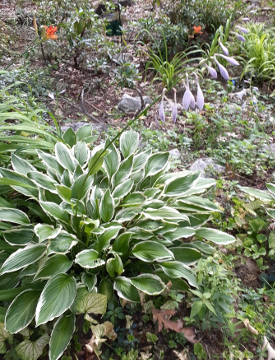
[25 July 2020] As July comes to a close, more hostas are starting to flower. Most gardeners grow hostas for their foliage, but I like their flowers as well. The flowers somewhat resemble lilies, which accounts for the "lily" part of the hosta's other common name, plantain lily. Hostas originally were placed in the lily family (Liliaceae) before they were moved to the asparagus family (Asparagaceae). It sure sounds like a demotion to me, sort of like telling someone who's been raised with the nobility that they are actually commoners after all. To add insult to injury, the "plantain" part of plantain lily comes from the fact that someone though hosta leaves resembled the leaves of the plantain weed (no relation to the cooking bananas called plantains). Hostas are native to northeast Asia: Japan, Korea, and parts of China. I'm guessing that when Europeans saw them, they said something like "It looks like a lily on a plantain weed. Hey, let's call it plantain lily."
"Hosta", which is also its genus name, was derived from the name of Austrian botanist Nicolaus Host. Host himself doesn't seem to actually have done much if anything with hostas. They were named to honor him by another Austrian botanist. However, Hosta as a scientific name for the genus ran into trouble. It was thought that the name had been used for some other genus, which by scientific naming rules made it invalid for the hosta plant. Thus, the genus was renamed Funkia in honor of Bavarian botanist Heinrich Funk, and in some places today another common name for the hosta is the funkia. Finally, research showed that Hosta was not invalid, and the genus became Hosta once again.
So, what's all the ado with naming the plant plantain lily, or hosta, or funkia? Didn't the Asians ever notice this leafy plant growing underfoot and gave it name? Of course they did, yu zan shu (China), giboshi (Japan), and (apparently, I'm not completely sure) bi bi chu sok (Korea). So why didn't the Europeans bring back an Asian name when they brought the plant to Europe? Actually, they did. The Dutch were the first to bring hostas to Europa. They gathered them in Japan and brought back the name giboshi, but this mostly fell out of favor for hosta and funkia. To complete the circle, the Europeans and Americans derived many showy hosta cultivars from Asian hostas. Later, many of these cultivars were imported into Japan, and the Japanese call them "hosuta" to differentiate them from their native giboshi.
Peonies and Hearts Corner
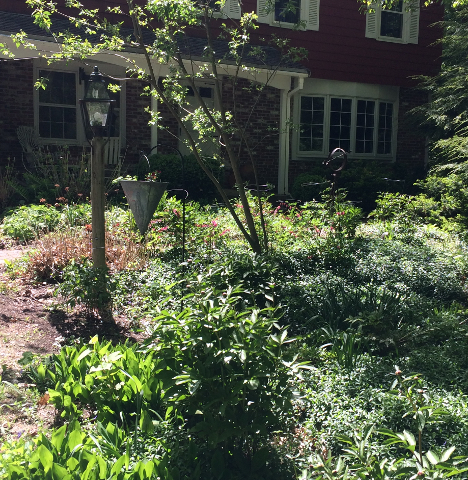
[24 May 2020] The approach to the house is lined with peonies, which will likely bloom in a week or two, and bleeding hearts (you can just make out the splays of pink flowers in the back). For a long time the bleeding hearts were specimen plants only growing where they were planted, but now they are naturalizing and spreading out.
The scrapyards of Brimfield can be seen in the metal hanging cone on the left, an old-style fire bucket (and it even has "FIRE" stenciled on it), plus the rusty astrolabe-like thing in the back. OK, it's really a stylized, pseudo (non-functional) armillary sphere, but they're also called spherical astrolabes.
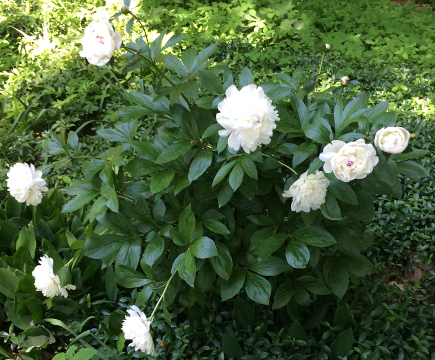
Festiva Maxima Peonies (note the touch of red in the
center of the double white blossom)
[06 June 2020] Two peonies began blooming today (Saturday) or yesterday; I'm certain none were blooming on Thursday.
[13 June 2020] More peonies are in bloom.
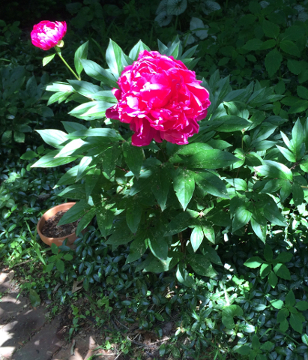
Magenta-colored Peonies
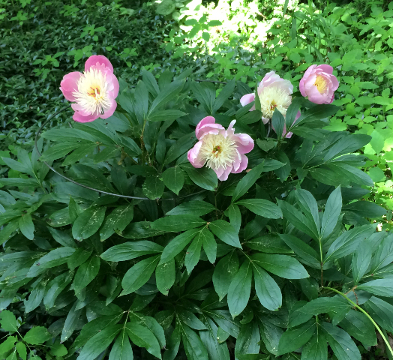
Pink Peonies
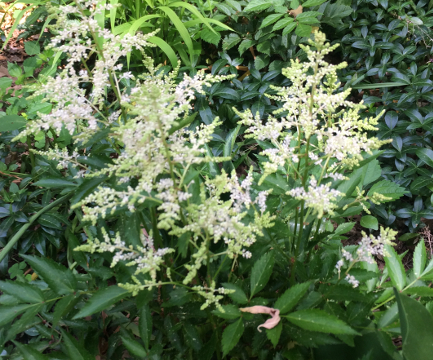
[27 June 2020] The first of the astilbe (ah-STILL-bee) is in bloom, a white one. A pink one may be in season next week. I think an astilbe flower looks a bit like a fern transformed into white flowers, but others apparently disagree, as another name for them is false goat's beard.
When we first bought the house, we knew we were going to need many shade-tolerant plants, because of the yard's many trees. We soon got an astilbe, which likes shade, and planted in the upper part of the Hill Garden. Year after year it came up and didn't do much. In fact, it did less and less. Well, that's the way with some plants, we thought. One year we were looking at shade plants to buy and saw astilbe -- nope, doesn't do well in our yard. Luckily, one of us read the plant's care guide and realized that our astilbe was in a much-too-dry location. (They're Goldilocks plants that cannot stand too-wet or too-dry soil.) We transplanted ours to a moister location and the next year it grew great.
I wish that was the end of the story, but, wait, there's more. We later planted more astilbe but forgot about the too-moist condition, so one went in the very moist ground next to the stream. It did well for a few years but then just disappeared. Oh well, live and don't learn.
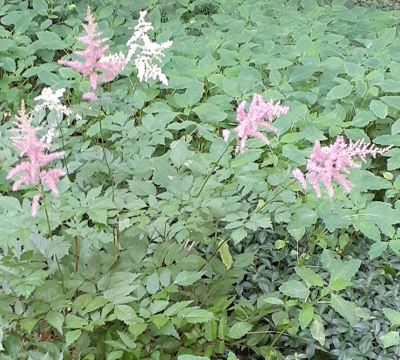
Pink Astilbe
[05 July 2020] The pink astilbe are now in bloom, along with more white astilbe. That somewhat ominous horde of plants around them are orange touch-me-nots, still in their growth spurt. See Looking North for more about these plants.
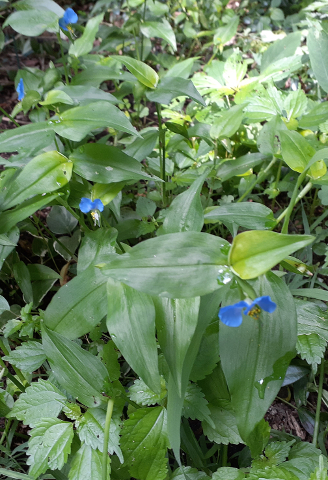
Asiatic Dayflower
Asiatic dayflowers!
These are very distinctive but small wildflowers with two bright blue petals, a small white lower petal, and yellow stamens (technically, these are staminodes since they do not produce pollen). It's called a dayflower as each flower lasts only for a day, although the plants flower from summer into autumn.
The flower is common to eastern Asia, and the Japanese once used the blue petals to make a blue dye for use with woodblock prints. The plant was brought to Europe and North America, where it escaped captivity and became a wildflower that some consider an invasive pest. Not me. I like them, and they grow in my yard almost like a ground cover in places that often would otherwise be covered with weeds.
In the lower left corner under the dayflower leaves there is a false nettle. I've also seen some "true" nettles, called stinging nettles, starting to grow. When they get bigger, I hope to take a picture and tell you A Tale of Two Nettles. It was the best of nettles, it was the worst of nettles...
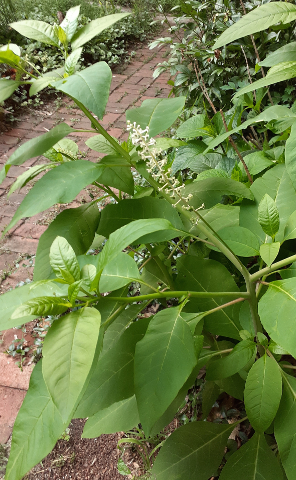
Monster Plant in Flower
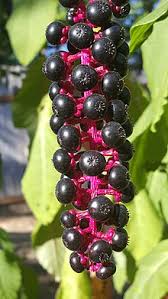
Berries of Monster Plant
(from the Internet)
Earlier I had Mystery Flowers, now I have Monster Plant. When the first stalk and leaves came out, I suspected what it was, and now with the flower developing, I know I have a monster in my yard... pokeweed, also known as American pokeweed, pokeberry, or American pokeberry. It's actually a fascinating plant and can grow into a huge bush; I've seen some about eight feet high. The flowers turn into distinctive blackish-purple berries. Emilie and I had seen it many times in our walks through the woods. It almost always grew in the same spot on the Sterling portion of the Mass. Central Rail Trail until 2018, when it wasn't there for the first time in a decade or more. I suspect someone cut it down.
Why do I call it Monster Plant. Why would someone cut it down? Why is it in my yard? For the first two questions, the answer is: the entire bush is poisonous: roots, stems, leaves, and berries! Oddly enough, the berries are the least poisonous part of the plant, despite their appearance. Many people have gotten sick and some have died from eating parts of the plant. People being what they are, someone discovered that the stems and leaves can be eaten safely if you cook them properly. The sap of the plant is also toxic, but most people coming in contact with it only get a rash.
Some people grow pokeweed in their yards as a specimen plant, because of how it looks. Not me, I'm going cut it down, as I don't want this monster in my yard. I may have a fight on my hands, as the plant by now probably has built up a strong tap root and will keep sending up shoots.
As to how it got in my yard, birds don't find the berries poisonous and eat them, spreading the seeds as they digest their meal. This was going to be the end of the story, but I've found a personal connection with pokeweed. When Emilie was young, her mother often told her how some relative ate inkberries and died. (Whether this is true or not is unknown. Emilie's mother also told her that sleeping with a fan on can cause pneumonia, which is not correct.) Emilie would tell me the story almost every time we saw some strange berries in our walks. I once ate some wild strawberries we found in front of her. Grandmom Astell taught me about wild strawberries in my visits with her. She grew cultivated strawberries, but wild strawberries grew in the fields near her house. They are safe to eat and tasty, but they are quite small compared to the cultivated ones. Anyway, apparently eating a few wild strawberries convinced Emilie I was some proto-Euell Gibbons in danger of eating any and every berry I saw in the wild, so I heard the inkberry story often. In doing my fact-checking about pokeweed, I just today discovered than another name for pokeweed is inkberry.
[08 Aug. 2020] A Tale of Two Nettles
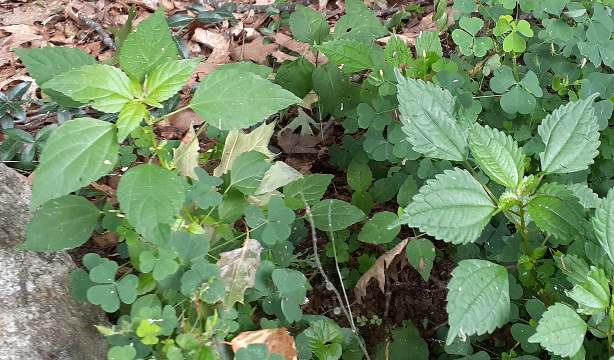
The picture shows two nettles. You might on a glance think they are the same species, but look closer. The nettle on the right is darker green, has toothier edges on its leaves, and (not so easily seen in the picture) has shinier leaves. The nettle on the left is lighter green, less toothy, and less shiny. No big deal? Yes, big deal. Know your nettles and you won't get hurt.
The plant on the right is a kind of false nettle (there are several different types). It is harmless to touch. It likes my yard, particularly the front hill next to the stream, and hundreds grow there.
The plant on the left is a kind of stinging nettle (there are several different kinds). It can be quite painful to touch. It is covered with small, hollow "hairs" that can inject stinging chemicals into your skin. The hairs can also break off on your skin, irritating it mechanically. The result for many people is a stinging sensation when touching the plant followed by a stinging or itchy rash that can last for days. Some people have an allergic reaction to contact with the nettles' chemicals, and this can even be life threatening.
I was aware we had false nettles in our yard. One day, Emilie was weeding out front and came in with a painful stinging rash. She said the false nettles caused it, which didn't seem right, so I investigated. I eventually noticed that about 1 in 20 nettles looked a bit different, and some research revealed that they had to be stinging nettles.
This tale of the two nettles ends with a complete recovery by Emilie after several days of discomfort and caution on both our parts around anything nettle like. As you can see in the picture, the two nettles easily grow side-by-side. Look before you touch!
The Front Garden
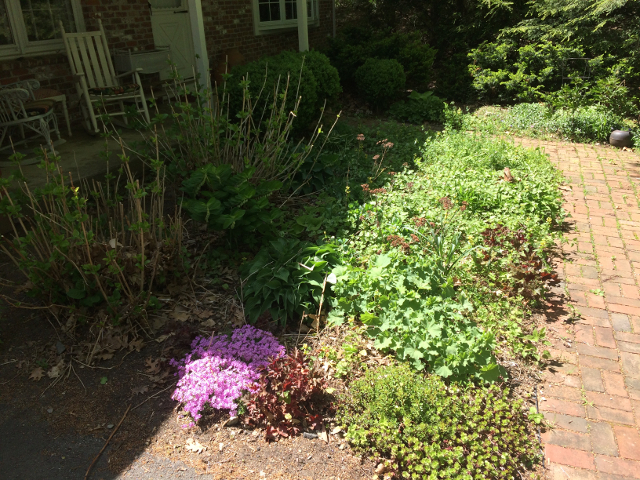
[24 May 2020] The shade does a number on this picture, but there's two hydrangeas in the dark. Other than the pink creeping phlox, which is ten times its original size, the garden right now looks like some big salad of green- and red-leaf lettuce. This will change as the plants continue to grow, with flowering pinkish-purple hostas, stonecrops, and yellow-flowering lamiums.
That black, round thing in the back was forged at the Cracks of Doom by Sauron himself as the one planter to rule all the planters. Just kidding! It's a large, black iron teapot from Brimfield-Dur being used to grow a garden lobelia.
Where's Waldo? He's not here, but can you find the rusty-white swan? You can only see its head. Despite how small it looks, the swan is the same size as the one in Emilie's Garden.
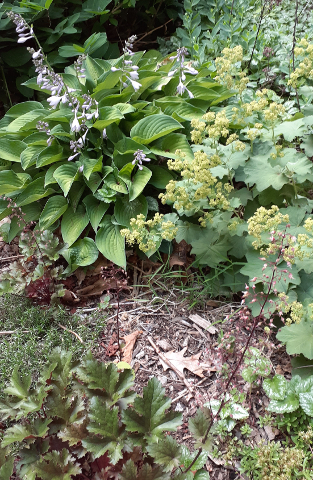
[05 July 2020] The Front Garden is coming along fine, looking less and less like a large salad. At the top left a hosta is in bloom. Almost all my hostas bloom in August or September, but this variety is always early.
Next to the hosta on the right are lady's mantles. The name comes from Europe's Middle Ages, where the plant's lobed leaves were thought to resemble mantles worn by women. Back then, common lady's mantle was used as a gynecological medicine. The plant is also called dew cup because of how its leaves collect dew. If that's not enough, it's scientific genus name, Alchemilla, comes from its use in alchemy. Alchemists believed that this dew was the purest form of water and tried but failed to use it to turn lead into gold. Scientists later laughed at the alchemists for their ignorance, but this didn't stop the Allies in World War II from mounting a raid into Norway to destroy the Nazis' only major source of dew cup water, which they needed for their atomic bomb project. Oh, wait, that might be heavy water.
In the front on the right you can see a skimpy stalk of coral bells, named for their coral-colored bell-like flowers. Coral bells are woodland perennials that like shade, so the Front Garden is usually a good place for them. However, they also like moist soil, and until recently it was probably too dry for them, hence their skimpy bloom.
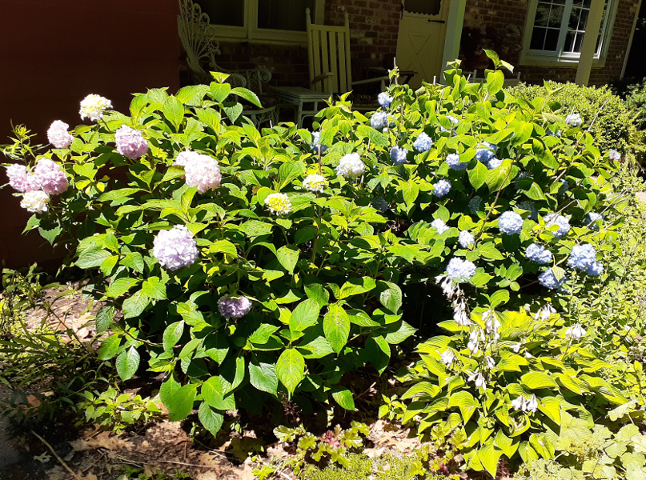
[18 July 2020] The two hydrangeas by the front porch are blooming. Yes, the one on the left has light pink blossoms and the one on the right light blue. These hydrangeas are the kind whose bloom color dependents on their soil's pH: alkaline soil creates pink colors and acidic soil creates blue. You can buy soil enhancements at some garden centers that are formulated to promote pink or blue blossoms, but I didn't. This shows just how quickly the soil's pH can vary in small spaces.
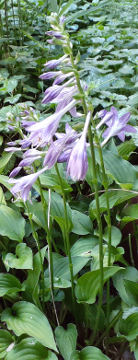
[01 Aug. 2020] More hostas are flowering. Hostas comes in a wide range of sizes, from giants that grow over 4 feet high and 6 feet wide, with giant leaves, to miniatures that can max out at about 3 inches high and 6 inches wide, with, of course, small leaves. The one in the picture is a compact hosta, about midway between a miniature and a "regular" hosta. I particularly like its abundance of purple-lavender flowers.
We tried growing a giant hosta once. This was a cultivar (whose name I forget) that featured quite large leaves. It didn't do much the year it was planted, as is typical of newly-planted hostas in my experience. I suspect the newbies spend most of their energy building up their root systems rather than their top-growth, which makes perfect sense for a perennial that wants to be around a long time. (An alternate theory is if I lavishly watered the noobs during the summer, they might have grown more.) The next year, it grew great. The year after, it started a run of bad luck. Some animal, likely a deer, stepped on it one night. It turns out the giant leaves put a lot of strain on their stems, making them brittle. Its leaves died off, but the hosta grew again the following year. We put a modified tomato cage around it to try to support and protect it, but a thunderstorm caused a huge tree limb to break off. Of course, it crashed down on the hosta, knocking it out for that year too. One year later, we thought it was gone, but it finally came up much later than the other hostas. Yet another year later it was coming up on time and looking good, but it's luck hadn't turned. Yet another unforeseen accident wiped it out, this time for good.
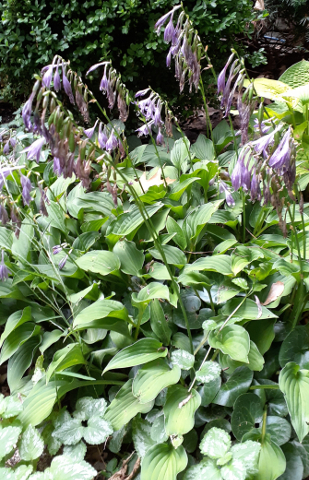
[15 Aug. 2020] Some of the hostas are at the height of bloom. Whoever said hostas are mostly grown for their foliage, not flowers, must not have seen this beauty. There was a bumblebee harvesting the flowers, but try as I could, I couldn't get it in the picture. Whenever it landed, it climbed up the tube of a flower and disappeared from sight. Then, it simply flew away to parts unknown.
Looking North

[24 May 2020] This view is from the front sidewalk looking north, with bleeding hearts, lobelia, those blue flowers whose name I keep forgetting no matter how often Lisa tells it to me, and, behind them, greater celandine. I've always called it yellow celandine, but since lesser celandine and celandine poppy are also both yellow, I guess that doesn't make much sense. Greater celandine is a wildflower that grows on the hill sloping up from the stream to the sidewalk and driveway. Like most wildflowers, some years there's a lot of them and some years there's few.
In addition to the black pot and armillary sphere, there's a rusty garlic head on a looping rod, perhaps my favorite lump of rust from Brimfield.
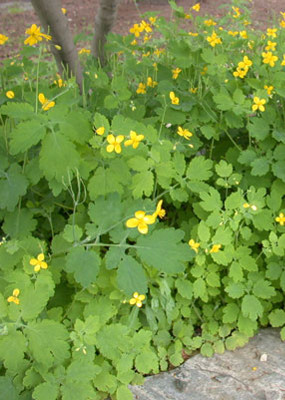
Greater Celandine (picture from the Internet)
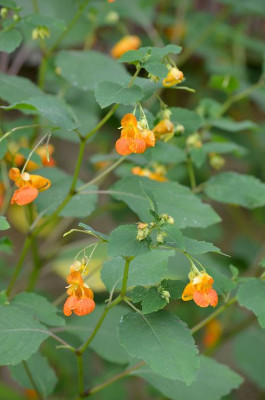
Orange Touch-Me-Not (picture from the Internet)
Greater celandine is a spring bloomer, which works out great for the plant, since orange touch-me-not, another wildflower, takes over there in the summer and autumn. It all but the driest years, dozens if not hundreds of orange touch-me-nots grow from the stream to near the top of the hill. The touch-me-not part comes from when the plant goes to seed, with the flowers drying out into pods that shoot out their seeds when touched. At least, that's what I've read; I've never touched a pod (the plant doesn't look like much after it's done blooming). Orange touch-me-not is also called orange jewelweed, spotted jewelweed, spotted touch-me-not, and so on. The "orange" in its name comes from the fact that there's also a yellow touch-me-not. This is a more rare plant, which I've seen on walks in wet places but never in my yard.
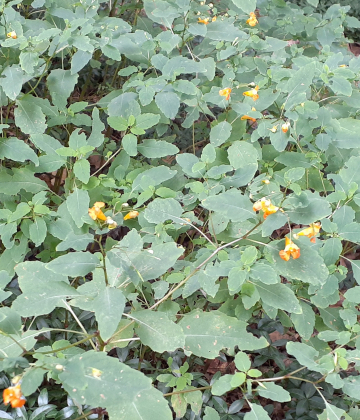
[30 August 2020] The orange touch-me-nots are flowering well. They've been blooming for at least two weeks, but it has been difficult to get a good picture of the flowers (my camera usually focuses on the leaves, making the flowers blurry). While I still have dozens of these plants by the front stream bed and on the front hill, the drought has felled hundreds of them. Even though they need moist soil, the ones by the stream bed are doing worse than the ones higher up on the hill, the opposite of what I would expect.
I write "stream bed" as the stream dried up in mid June and despite several rainy days in the past week it so far shows no sign of flowing again. The stream is in the lowest part of my yard and flows or not depending upon the height of the water table. If I dig a hole in the ground near the stream, I'll hit water. In normal years the stream does dry up in July and August, but the water is only 3-4 inches below the surface. This year I bet the water is deeper down.
Around the Side, the Side Garden
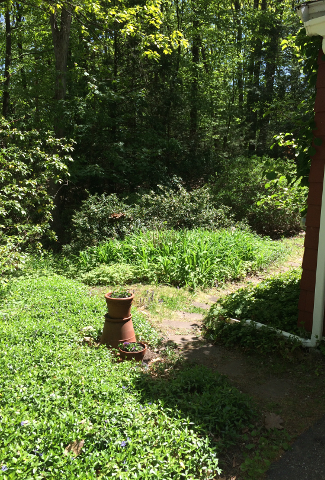
[24 May 2020] Now we're heading around the left side of the house, by the garage. The two pots cover a bare spot in the vinca that opened up last year for some unknown reason. Behind them are Stella d'Oro daylilies, which will bloom in a few weeks in a great golden-yellow glow. Behind them are two holly bushes, a male and a female, so that the female can produce red berries in the autumn. On the right is the Green Monster, a huge forsythia. It's over eight feet tall in places but the perspective of the picture makes it look smaller.
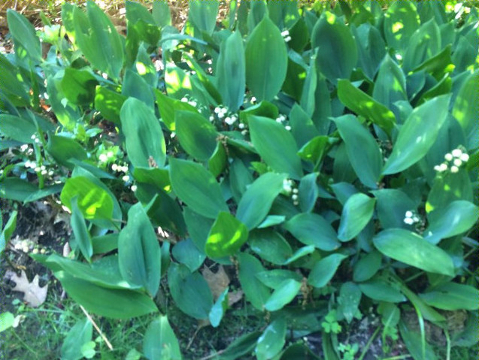
Lily of the Valley
[30 May 2020] Lily of the valley, a wildflower, is now in bloom.
Lily of the valley has come up every year next to the Green Monster from as long as we've lived in this house. For a long time, it only grew next to the monster and slightly up the adjoining hill (along the path into the back woods). Over the last 5-10 years, however, it has been gradually spreading into the back yard, under the crabapple and into the bearded iris patch. I'm OK with it under the crabapple, as amazingly it is giving the vinca, ivy, and invading pachysandra there as good as it gets. The bearded irises, however, need protection, so the lily only allowed along the fringe of this garden.
[06 June 2020] Geraniums of all sorts grow well in the gardens. The picture on the left is a wild or "hardy" geranium (also called cranesbill). This is a wildflower that yearly volunteers to grow in my various gardens and other places. The picture on the right must be another variety of wild geranium. The leaves are a distinctly different shade of green, and the pink flowers are a bit different, too.
Wild Geranium, Hardy Geranium (Cranesbill)
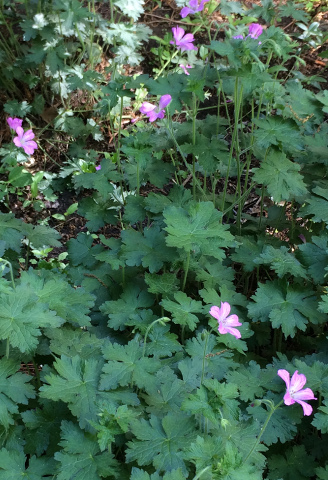
Another kind of Wild Geranium
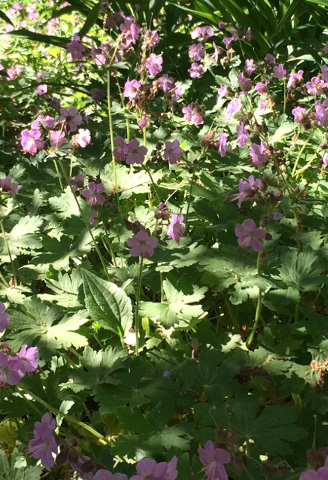
In the Back Garden, there's a pair of yet another kind of geranium that comes up every year. This has small purple-ish flowers and the classic green-and-red geranium leaf. However, since "real" geraniums ("pelargoniums" or storksbills) are not perennial in Zone 5 where I live, Purple-ish has got to be yet another wild geranium.
I do have a couple of "real" geraniums growing in planters in the gardens, the classic type with deep-red flowers. I'll take a picture of one when it comes into its own in the middle of summer. 20 June 2020 Update: See the 20 June 2020 picture in Emilie's Garden, Upper Entrance for the red geranium.
Wait, why are "real" geraniums actually called pelargoniums? Originally, all were classified as various species of genus Geranium. Later, it was noticed that although the plants, leaves, and flowers all looked similar, there were two groups of species, each group differing from the other in visually insignificant but botanically significant ways. The solution was to kick one group into a new genus, Pelargonium. However, the plant-loving public already knew and loved them as geraniums and continued to call them that.
I'm not a fan of calling flowers by their scientific names. Yes, many garden books try to convince you otherwise, but the two-part Latin-ish names often have no flavor. Also, the rules of giving a plant or animal a scientific name are very exact and very arbitrary. Puffinus puffinus is not a cute puffin, it's a rather homely shearwater (go look it up). Also, if the namer makes a mistake, correcting it is almost never allowed. Oviraptor is a dinosaur with a name meaning roughly "egg hunter" because its first fossil was found on top of a clutch of fossil dinosaur eggs, and it was assumed that the dinosaur got fossilized just before it was going to have breakfast. Many years and fossils later, it turns out that "oviraptor" is a nesting dinosaur that broods its eggs. So, rather than being an egg thief it is an egg protector! But, there's no chance the inappropriate name will be changed.
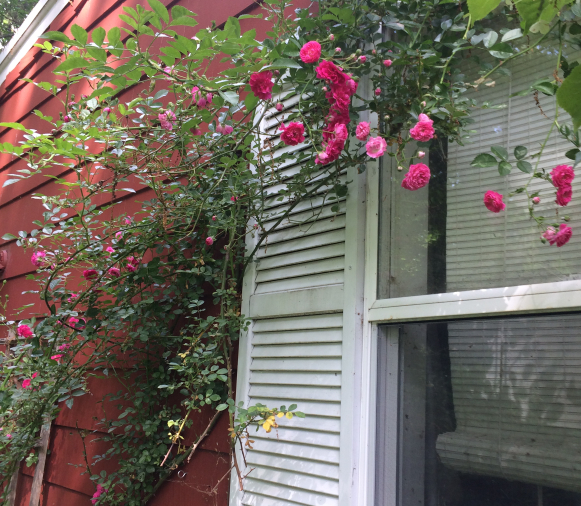
[27 June 2020] Willful Rose is blooming. The Hill Garden had clearly been landscaped a long time ago when we bought the house. It also clearly had been ignored for years and was badly overrun with invasive plants and was turning wild. It took few years to clear out the invaders, and we discovered a small but tenacious rose growing on the hill; perhaps evidence that at least part of the hill had been a garden. The rose grew a cane or two every year while surrounded by ferns. It was so tenacious we finally decided to transplant to a better location: on the side of the garage next to a trellis. While the rose did grow on the trellis, it has a mind of its own and tried to grow all over the place. I've let it jump the trellis and arch over the window.
We sometimes called it a wild rose because of its behavior and small flowers, but its double blossoms mean it really isn't a wild rose, which only has five single petals. Accordingly, I'm now calling it Willful Rose.
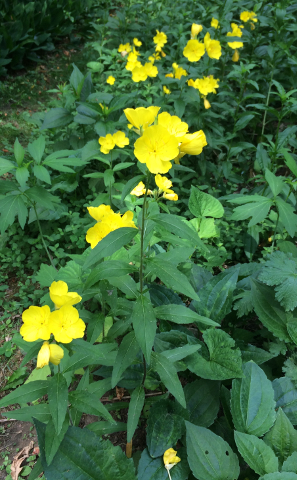
Sundrops have dropped in. If you look at the flowers, you might think these are common evening primroses, but they're not. Common evening primroses, and most evening primroses in general, close up their flowers during the morning and only open them again in the evening. As you might guess from this behavior, their pollinators are evening and night-time insects, like moths. However, sundrops are open all day, which makes them one of my favorites.
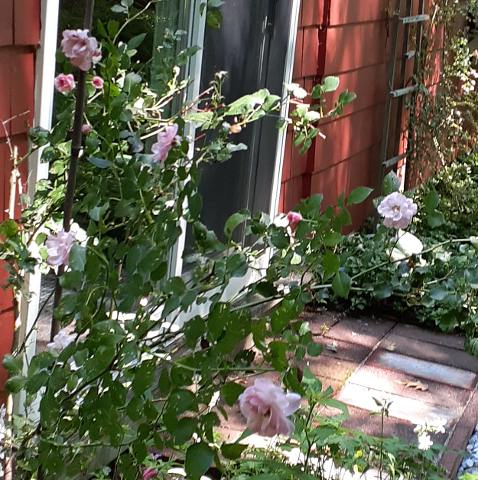
[18 July 2020] Meet the so-called Fairy Rose. A long time ago we bought a half dozen rather inexpensive rose bushes that were labeled fairy roses from a nursery that rarely had inexpensive plants. When we bought our house it had a hedge of four-foot-high bushes along the back of the house where the Back Garden now is. They did nothing useful or decorative for the back yard, so one year we cut them all down and dug out their roots. For as long as I can remember, I have had serious allergies often triggering asthma. Surprise, Emilie was allergic to them, not me! Her reaction was moderate (no medical attention needed), but she had to completely avoid them and stay inside until I got rid of them.
Five of the fairy roses went where the bushes had been, the first plantings of the Back Garden. They did OK for maybe two or three years but then mostly died off. Once in a while, a cane still sometimes comes up. Since it is sunny enough for fairy roses there, I suspect the soil was not suited for them. Possibly the bushes had depleted the soil. The sixth so-called fairy rose went into the Side Garden, where it is still doing fairly well a couple of decades later. It's only problem is the nearby crabapple tree has grown much taller and now shades the area a bit too much.
What's the deal with calling this a "so-called" fairy rose? Fairy roses are short bushes, rarely over three feet high and are covered in clusters of double-blossom roses. This so-called fairy rose grow four-to-six feet tall and does not have dense clusters of roses. The roses themselves are double-blossoms and the right size for a fairy, but the height and lack of clusters cast serious doubt that the bush is a fairy rose. As far as I can remember, the other five bushes grew the same way as this one does. Perhaps the nursery mislabeled the bushes. Perhaps the fey from the Faerie realm sprinkled them with magic growth dust.
[01 Aug. 2020] Black-eyed Susans and possibly a helleborine are here.
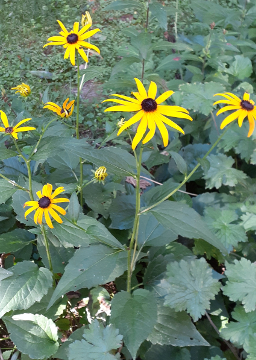
Black-Eyed Susans
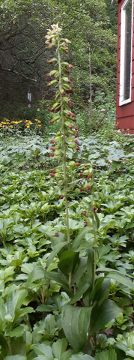
Possibly a Helleborine
Wildflower black-eyed Susans are now blooming in the side and back yards. As discussed here, domesticated gloriosa daisies were originally derived from wildflower black-eyed Susans.
I'm not sure what the plant shown on the right is, but my best guess is that it's a broad-leaved helleborine. I have two or three of them growing uninvited in my gardens. The flowers are rather unattractive, but I am going to let them grow at least for a while longer in hopes of being able to identify them better. Helleborines are orchids, and there are dozens of different helleborine species. Most, however, require wet conditions, but the broad-leaved helleborine can grow in a fairly wide range of environments. Broad-leaved helleborines were brought to North America from the old world and soon escaped from gardens, naturalizing themselves in both the eastern and western regions of the USA and Canada. Some people consider them invasive and call them weed orchids or weedy orchids.
"Helleborine" was derived from "hellebore", as someone thought helleborines resembled hellebores. Hellebores are a totally different group of plants that are not even orchids. There seems to be some dispute about the meaning of "hellebore", but the version I think mostly likely claims it derives from Greek words meaning "injury" and "food". All hellebores are toxic to people, so "injurious food" makes sense. All I can is that my hellebores, Lenten roses, won't ever be featured in a salad.
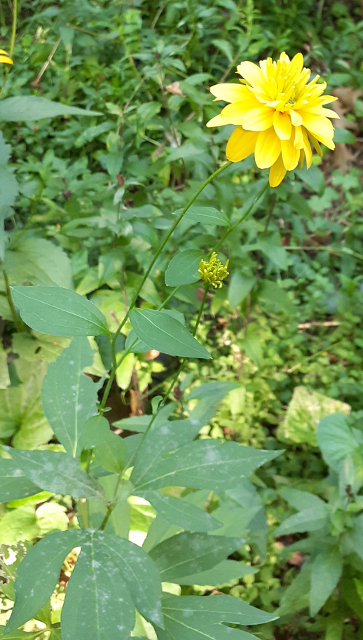
[22 Aug. 2020] At first glance I thought these were perennial sunflowers (I have two or three) that managed to jump from the back garden to the side garden by the three-season porch. More glances brought doubts: the leaves are deeply cut unlike the sunflowers', and the yellow blossom is the right color but lacks the center like a sunflower. So it's not a perennial sunflower.
OK, so my next thought was that it was some first-time wildflower visitor, as I have never seen a flower like this in my yard before. However, I could not find it in my wildflower guide, and it's striking enough that it should have an entry if it's a wildflower.
My third step was to upload the picture of the flower to Google Images, even though it is not very good at identifying flowers. (Images for example didn't even recognize my wildflower broad-leaved helleborine as a flower but instead claimed it was a pine cone!) Images did recognize this yellow flower as a flower but suggested is was a cosmos. It clearly isn't. However, it offered a lot of "visually similar images", so I scrolled through them until I saw a ... cutleaf coneflower. The blossom is right. The leaves are right (hence the name cutleaf). The height is right. Despite being a "coneflower" (a rudbeckia), it doesn't have cone, right. OK, it's a cutleaf coneflower; best match is Rudbeckia laciniata 'Goldquelle', the coneless coneflower. Coneflowers can spread by seed around here (we've had purple coneflowers in the past that seeded for a while), and some kinds of birds like to eat its seeds. I figure these cutleaf coneflowers are the best thing I've gotten from bird droppings.
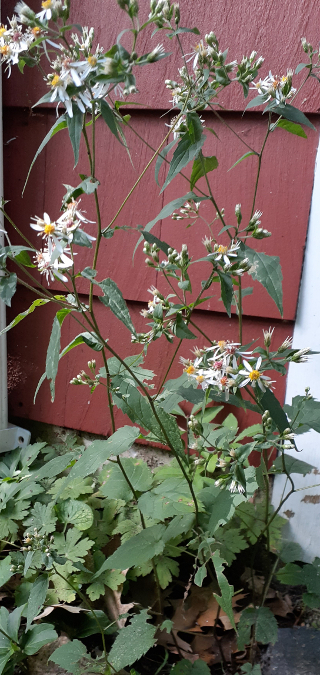
[30 Aug. 2020] White woodland asters (also called white woods asters) are in bloom. Around there, these are wildflowers that flower in the last month of summer. They like shade and won't grow in full sun. Supposedly they do best with about three hours of sun per day, but they usually grow quite well along part of my woods path which gets little summer sun. They spread by seeding and via roots. At least in my yard, they do not spread quickly, which is unfortunate as I have several shady places I'd like them to grow.
Sometimes parts of my yard are large patches of bright white from the asters. This year with the drought, they are not blooming as profusely.
Some nurseries do sell them (they are hardy in Zones 3 to 8), but I haven't noticed them for sale around here (although I don't look for them in nurseries, since they grow wild in my yard).
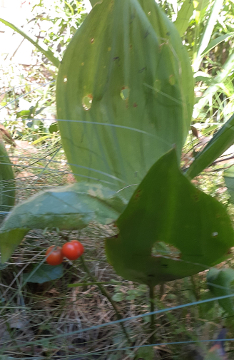
[5 Sept. 2020] Back in May, I had a picture of the lilies of the valley in bloom. About three months later, the flowers are now red berries.
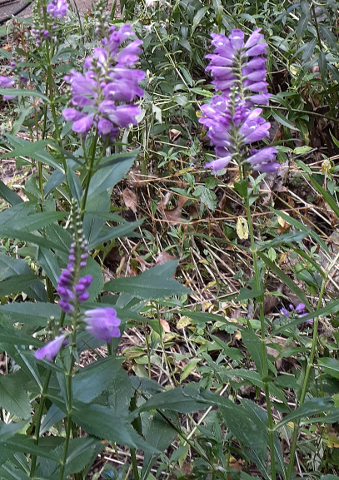
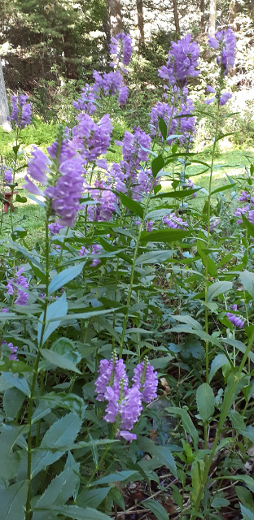
[12 Sept. 2020] Obedient plant is blooming like mad now. I like this flower as it has quite colorful blooms for late summer and autumn. The flowers look a bit like snapdragons, and another name for obedient plant happends to be false dragonhead.
The "obedient" in the plant's name comes from the fact that you can bend the flowers in almost any direction you want and they will stay that way. Many people, however, think the "obedient" name is a practical joke to get them to grow it, as it will aggressively spread through the garden you plant it in.
[20 Sept. 2020] The obedient plants are blooming even better than last week, so here's another picture (on the right).
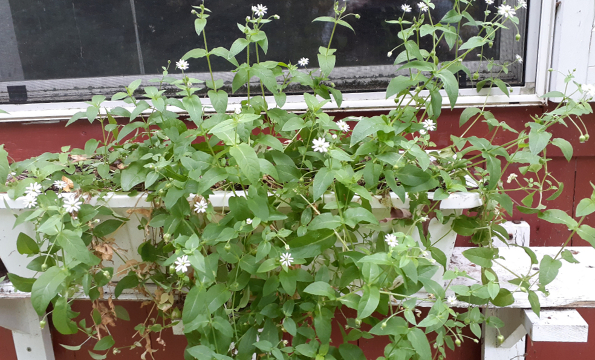
[27 Sept. 2020] This is a window box along the side of garage. I tried to grow impatiens there, but both batches failed to the rot that strikes these plants around here, just like what happened in the French lavage in the Sunken Garden. The flower in the picture grows naturally in both the window box and lavage but no where else in the yard. I think it is some kind of chickweed, or possibly stitchwort or starwort, as there are many species in these groups that all look similar. The plant is somewhat weedy looking until it finally flowers, but then the white, ten-petals (or, five, deeply-divided petals) flowers makes it look quite good.
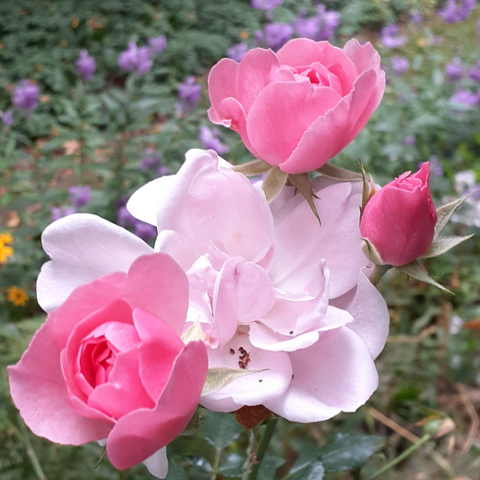
[27 Sept. 2020] The so-called fairy rose is blooming again, at least the third and maybe the fourth time it has had a cluster of roses blooming this year.
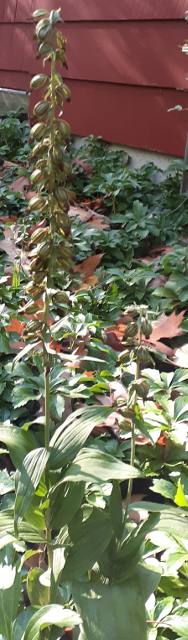
[17 Oct. 2020] Back at the start of August, I showed what I suspected were broad-leaved helleborines growing wild in my garden. Well, the ones in the side garden are still there, mostly unchanged from August except that they're a little browner than before. (I had two more in other places, but they disappeared over the course of the summer.) Although you can see two stalks, technically it is one plant, as a helleborine root (actually a rhizome) can send up multiple shoots.
The Back Garden
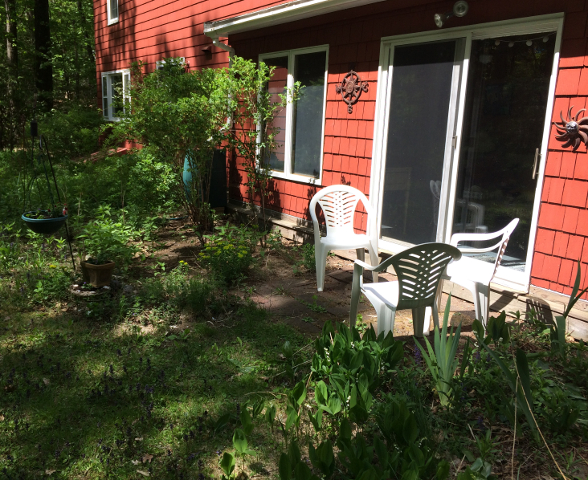
[24 May 2020] This is the Back (of the house) Garden, with bearded iris, chocolate mint, rosa rugosa, forsythia, redtwig dogwood, poppies, and lots more flowers. On both sides of the door are more Brimfield ironmongery. The "sun" on the right is some sort of agricultural device with a sun face that Emilie crafted and fired in clay. Not shown, there's two more sun faces to the right, each with its own unique expression. Wasps love to nest behind them but never bother anyone.
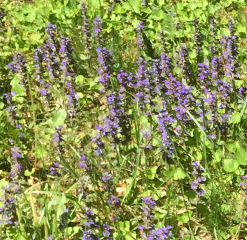
Ajuga
[30 May 2020] The ajuga is at the height of its bloom in the back yard.
Decades ago I gave up being a grass farmer and just let whatever wanted to grow in the back "lawn" grow. The only rule is that it has to be able to survive being mowed; every couple of weeks in the summer I walk an old-fashioned motorless push mower over the "grass". The rule is self enforcing; things that don't like to be mowed soon give up while things that don't mind being cut down to two inches survive. The ajuga soon arrived from who-knows-where (we never planted any). This is a colorful spring flower and bees absolutely love it. At first, the yard was full of honeybees on the ajuga for 2-3 weeks each year, but perhaps about 10 years ago honeybees became more and more rare, with none at all showing up about five years ago. Big happy bumblebees filled in instead, but I missed the honeybees. They finally started making a comeback in 2018 with just a handful, seemingly smaller than usual, visiting the ajuga. In 2019 there were more (and healthy-looking), and this year they finally outnumber the bumblebees, who of course don't care, happy souls that they are. The honeys are not at all close to being as abundant as they used to be, but time will tell.
Ajuga is exempt from being mowed as long as bees are visiting it. Very soon, the purple flowers will fade to brown and cease attracting bees.
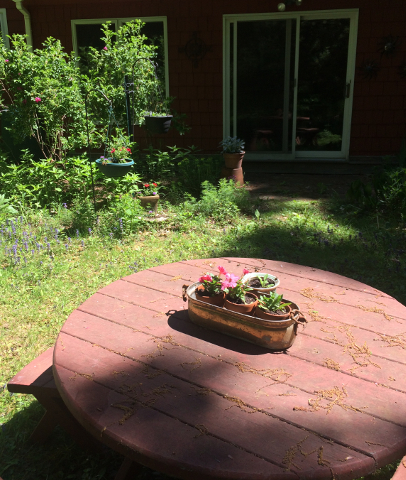
The Picnic Table
Emilie had this redwood picnic table back in the 1960s in St. Louis, and it followed her to Kentucky, Illinois, and Massachusetts. A few years ago Tristan and I stripped it down and repainted it; as far as I know that's the only maintenance it has ever had. The brown stringy things on the table are catkins from the oak trees. Catkins are the male flowers that oaks produce to fertilize the female flowers, which then develop into acorns. The catkins produce huge amounts of pollen, so their falling from the oaks often signals a let-up in the spring allergy season.
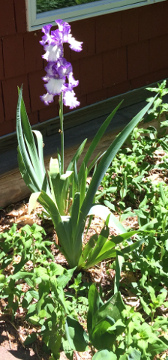
Bearded Iris
[06 June 2020] A bearded iris is in bloom!
There's maybe another five or six bearded iris nearby, but none of the others look like they're going to bloom this year. That's no surprise, as bearded iris need a bit of tending to thrive, and they haven't gotten much attention for a couple of years. We got our irises decades ago at White Flower Farm, a great but pricey nursery in scenic Torrington, Connecticut. They grew great for many years but later would just come up with leaves but no blooms. Lots of leaves; they had propagated all over the iris bed, and that was the problem. Thinning them out restored their blooming.
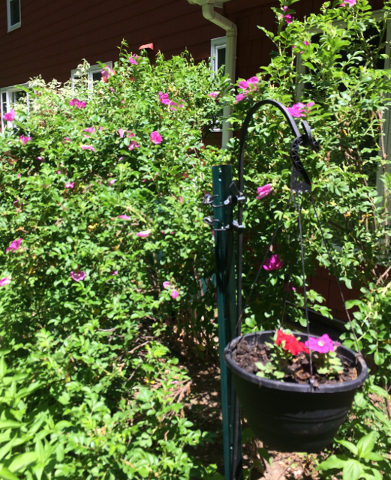
Rosa Rugosa in bloom
In just two weeks, the rosa rugosa has filled out and is now blooming all over with magenta-pink flowers.
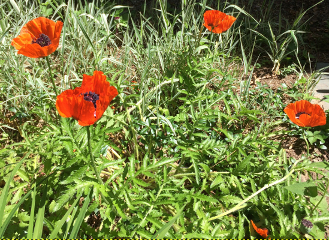
Oriental Poppies
[13 June 2020] This is the peak of my oriental poppy season.
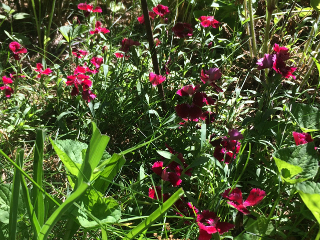
Dianthus
Dianthus are blooming. Dianthus are often called "Pinks" because many of them are pink but they can be red (see picture), white, or yellow, depending upon species and cultivar. Dianthus with double blooms are often called carnations! My dianthus self-seed almost every year, so the ones in the picture are descendants of dianthus planted a long time ago.
The heart-shaped leaves growing next to the dianthus are violet leaves. These violets are wildflowers and often flower all over the back yard in the early spring. Most are the traditional purple color but I almost always get a few yellow violets and once in a while some white violets.
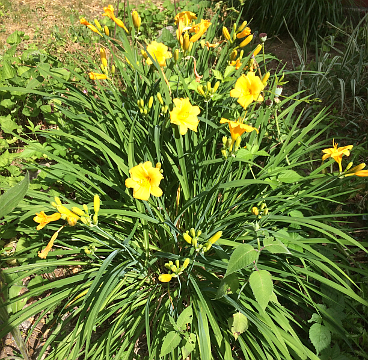
[27 June 2020] Daylily season has begun! The first of the Stella d'Oro daylilies has started to bloom. A few orange daylilies have also started to bloom on the Hill Garden, but I didn't take a picture of them. They will bloom like mad in other places in a few weeks, so expect a picture then.
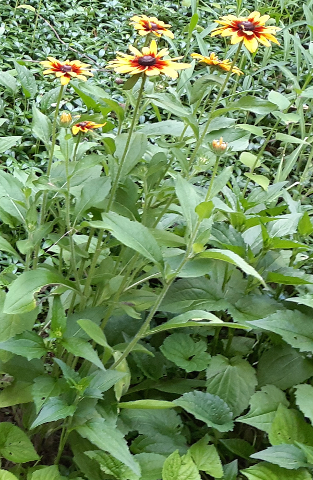
[05 July 2020] The gloriosa daisies have started their show. They have very distinctive petals, being red-orange around the central cone but turning yellow further out. We used to call them rudbeckia, but the Rubeckia or coneflower genus has a dozen or so different species. The gloriosa daisies self-seed in my yard, so they come up in different spots from year to year.
Gloriosa daisies were bred from ("are cultivars of") black-eyed Susans, wildflowers that have all-yellow petals. I often have black-eyed Susans growing in my yard, and they also self-seed. They jump around much more that the gloriosa daisies and at least here rarely grown in the same patch for more than a few years. Perhaps this is their way to avoid plant diseases and fungus. I'm not sure if I have any Suzies this year; I'll only know if they bloom.
[01 Aug. 2020] Update: I do have Suzies blooming in my gardens!
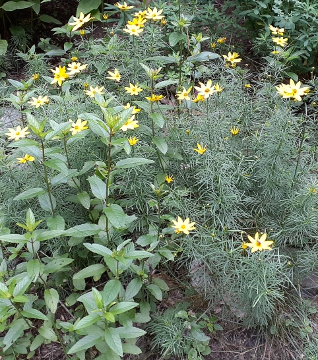
[11 July 2020] Moonbeam coreopsis is in flower. The "moonbeam" name does not mean it blooms only at night, as it blooms throughout day and night. Instead, perhaps the person who first bred it thought the pale yellow flowers were like moonbeams when compared to the bright yellow "sunbeams" of most other coreopsis plants.
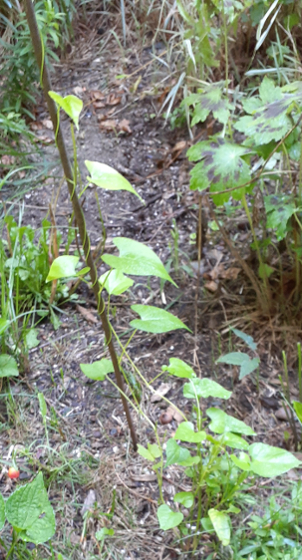
[18 July 2020] I planted this morning glory back in May. Within a couple of days, some bugs munched the plant, making huge holes in all its leaves. I watered it profusely and eventually it slowly grew back a new set of leaves but then just sat there for weeks. Last weekend it was still no larger than when I first planted it, nor had it made any move to grow up the nearby tripod. Today when I checked on it, the morning glory has taken off and is merrily wrapping its way up one leg of the tripod. We have lift off!
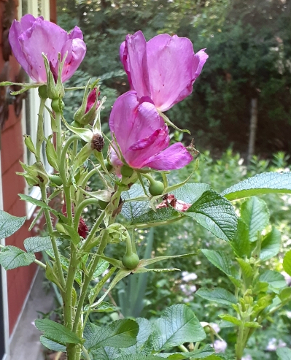
[25 July 2020] The rosa rugosa is blooming again. Here's a closeup.
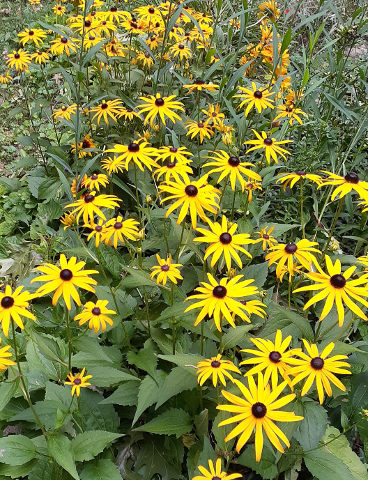
[08 Aug. 2020] Black-eyed Susans continue to pop up all over the place. The orangish flowers in the back are gloriosa daisies (a cultivar of black-eyed Susans).
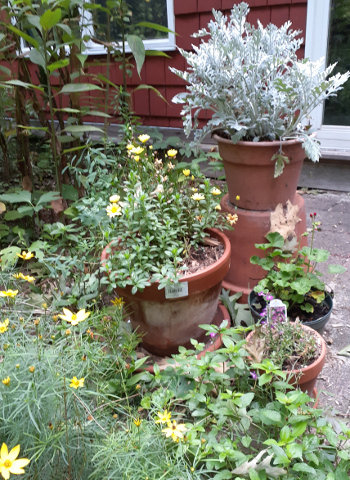
The distinguished, silvery-green plant in the upper right is dusty miller. It can have small yellow flowers in the summer, but most people including me grow it for its foliage. I somehow came to think that it was a perennial in my gardens, but winters here are way too cold for it to survive. It turns out I was confusing it with lamb's ear, a perennial greenish-silvery-gray plant. It survived many years in my gardens and spread a bit, but I haven't seen any for years. Maybe I'll plant some again someday. Another greenish-silvery-gray plant this is growing my yard this year is rose campion. This grows wild and doesn't always come back, so I'm lucky that a clump of three rose campions came up in the front.
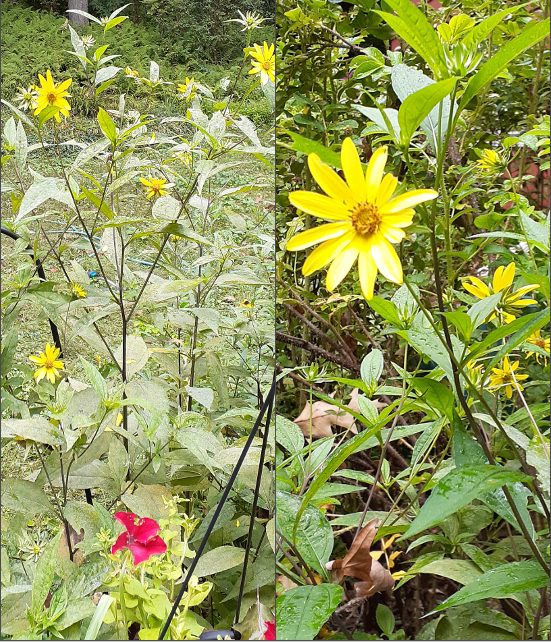
[15 Aug. 2020] If you are only familiar with the giant annual sunflower, it may be a surprise to learn that there many other types of sunflowers, most of them perennial. The name "sunflower" supposedly comes from the fact that the flower head of the giant annual version looks like a stylized sun. It took me a long time to learn this, as I had thought that "sun" flower meant it needed full sun. Imagine my surprise when Emilie and I identified some yellow flower growing in the woods as a woodland sunflower, in our Peterson's guide to wildflowers. Most sunflowers do need a lot of sun, but not all.
Perennial sunflowers do not produce huge flowers like the annual, but the flowers are beauties and do produce sunflower seeds that drive goldfinches crazy. Goldfinches are pretty but greedy birds; in the winter they will just perch on the birdfeeders for long periods of time guzzling down the black oil sunflower seeds we use. While they are there, smaller birds like chickadees will not go the feeders. Fortunately, the goldfinches eventually leave and do not come back for a long time, so other birds then get their fill.
When the perennial sunflowers go to seed, the goldfinches go wild over them, and you can hear them squabbling as they compete to get the seeds. Also, the stems of the sunflowers are not strong enough to remain fully upright when goldfinches land on the flowers, so it's amusing to see several sunflowers bending and swaying wildly when the goldfinches feed.
Aside: Winter Birdseed
At least in New England, black oil sunflower seeds are one of the best choices to feed birds. Many birds love them, as the oil content helps them survive the winter's cold and the thin shells are easier to crack open than the somewhat cheaper striped sunflower seeds. You could get a mixture of different seeds, which might attract a few more types of birds, but make sure there's plenty black oilers. Avoid any mixture that contains yellow millet (the tiny yellow seeds you see in the cheapest birdseed) or red millet. Very few birds will eat these millets and instead just spit them out on the ground while seeking the good stuff. (Not all millet is bad, many ground feeding birds like white millet. Don't bother to put it in a feeder, just sprinkle it over the ground.)
Rather than getting a mixture of seeds, however, I think it's better to branch out with different kinds of feeders and bird food. Many types of finches like oil-rich nyjer seed, which you may know as "thistle seed". Once, real thistle seed was used, but this fell out of favor because thistle seed that fell to ground could germinate into invasive thistle plants. Nyjer seed, from an African daisy-like flower, became the substitute. But, couldn't this spread African daisies? The seeds are heated treated to sterilize them. (Why didn't they just heat-sterilize the thistle seed? As best I can guess, invasive thistle is an agricultural pest, so it was probably decided to avoid thistle entirely, in case a batch wasn't sterilized properly.) There are a few issues to watch for with nyjer seed. If it gets too old and dried out, the oil is gone. Get rid of it because birds won't eat it. If it clumps up all wet and hard, get rid of it because birds won't eat it. If you just bought a new batch and birds won't eat it, it probably was heated too much during sterilization, depleting the oil. Get rid of it. If you can, find a store that sells birdseed by the pound, and just get small batches of nyjer seed every so often, rather than a big bad bag of nyjer that might go old before you use it all up.
Another great choice is to get a suet feeder and blocks of suet. The high fat content attracts many types of birds, include ones like woodpeckers and nuthatches that won't go to seed feeders. Just plain suet cakes work fine, although you can get suet cakes that also contain peanuts, berries, fruit, dried insects, and other ingredients. These supposedly attract birds that like those ingredients, in addition to the straight-up suet eaters. I've not noticed much of a difference.
The reason you don't see many perennial sunflowers in gardens is that they are invasive, spreading rapidly. We didn't know this when we got ours from Lisa, who got hers from a friend. The first few years they are great, but then you notice they keep taking over other parts of the garden. Most people apparently then pull them out, but we liked them and left them alone. In normal years, they grow six to eight feet tall. This year with the drought, they are averaging about two feet shorter. I'm hoping we'll get enough rain so that the flowers can develop into a full crop of seeds for the goldfinches.
I've been calling them "perennial sunflowers" because I don't know which species I have. There's about 70 species of sunflowers, most of which are native to North America and a few to South America. Since they are perennial in my yard and do spread, I'm assuming they are a species native to New England. This narrows down the choices a lot, since many sunflowers are native to places further south or further west. Even so, it's often hard to tell one species from another. My guess is that I have the pale-leaf woodland sunflower (which despite "woodland" in its name will gladly grow in meadow-like environments), based on comparing mine with Internet pictures of the pale-leaf woodland sunflower. However, other possibilities include the hairy sunflower and the pale sunflower.
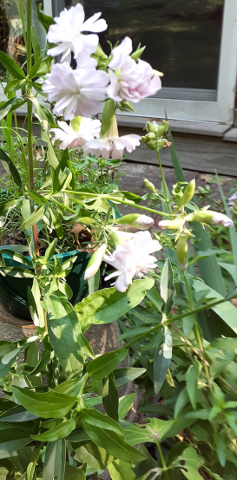
[22 Aug. 2020] This is some hybrid of garden phlox. The flowers almost look like they are double-blossom, but they are curled up like a rosebud and later uncurl as they grow. Two phloxes that are like this are Tiara (white ranging to light-yellowish cream flowers) and Creme de la Creme (white and light pink flowers). The colors of my phlox's flowers match neither hybrid. However, this phlox has been self-seeding in my yard for many years, and the flower colors of many phlox hybrids do not stay true to the colors of the original cultivar.
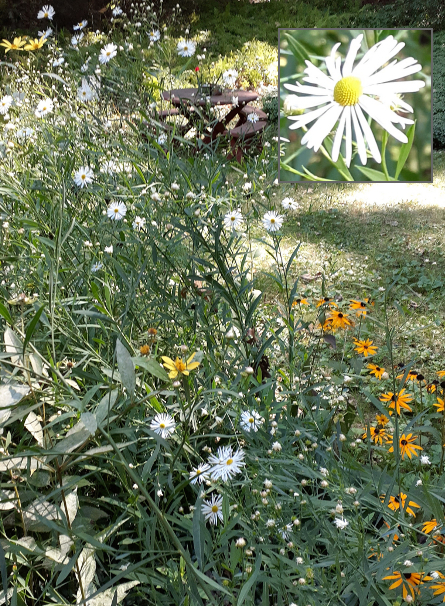
[20 Sept. 2020] Meet boltonia, sometimes called false aster. There are several species of boltonia; this most likely is Boltonia asteroides. It's a member of the Asteraceae (which means "resembling aster"), looks like an aster, and the asteroides part of its scientific name also means resembling an aster. So, why "false aster"? As far as I can tell, it's because its genus is Boltonia, not Aster. My boltonia are covered with happy pollinators who find nothing false about the plant.
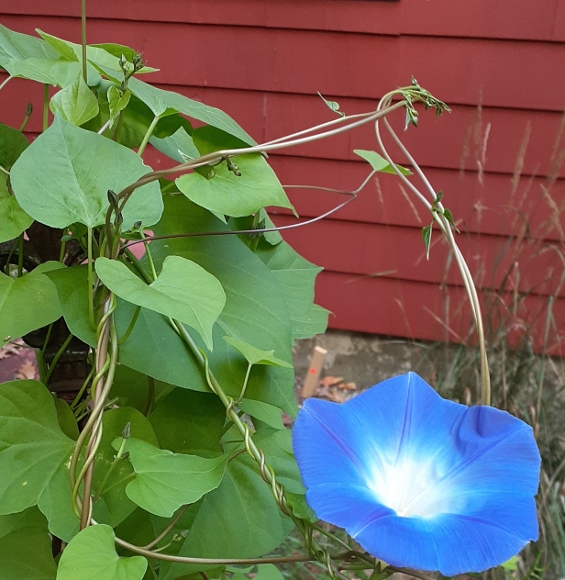
[10 Oct. 2020] The morning glory has finally bloomed! It was planted in May but its first set of leaves were eaten by something. It sat there for weeks trying to regrow a new set of leaves and then finally took off vining up its poles in mid-July. It was then clobbered by the drought and did not develop flower buds. Some buds finally grew in September, but a cold snap almost did it in, with some of the leaves wilting and yellowing. October, so far, has been relatively mild for central Massachusetts (although still rather dry), and the plant finally bloomed around 8 October. So far, there's only been one flower, but given what it has gone through this year, that's fine.
The Sunken Garden
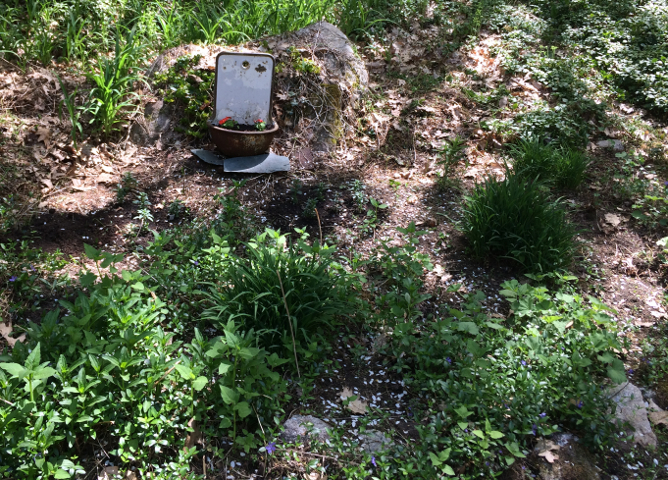
[24 May 2020] This actually is a sunken garden; the brown area is about a foot lower than the rest of the yard. When we first bought the house, the ground there was level, but there were two overgrown evergreen bushes there. They were too big to turn back into better-looking, smaller bushes, so we cut them down. Over the next few years, the ground where they had been growing gradually sunk. I figure that the bushes had extensive root systems, which as they decayed collapsed the ground above them.
We grew a variety of flowers here, and there's still some lady's mantle just coming up. In the back by the rock, which is larger than it looks, is the "French Lavage" Emilie got at La Ferraille de Brimfield. I won't tell you what I think it looks like. We've always grown some kind of impatiens here. For a long time it was the "standard" impatiens, Impatiens walleriana, that almost everyone loves. However, early in the 2010s, a disease swept impatiens all around here, rotting out the plants soon after they were planted. Nurseries stopped carrying them and instead sold New Guinea impatiens (Impatiens hawkeri) as a substitute. The NGs are good-looking plants but they're a bit expensive and just not "real" impatiens. This year, Spencer Greenery had real impatiens, so I figured the growers managed to breed a disease-resistant version. I got some, so we will see...
In recent years, the rest of the Sunken Garden was somewhat neglected and became to be overrun by both Japanese pachysandra and ferns spreading down the hill behind the rock. I've weeded them all out and planted a dozen snapdragons, which I hope will do well here, even though they are said to prefer well-drained soil. I think I'm going to add a dusty miller here, too, as this plant often does well in my yard.
[06 June 2020] The dusty miller went into a pot by the back garden. Dusty is listed as an annual around here, Zone 5, and supposedly only becomes perennial in Zones 8-10. I could have sworn that we had dusty millers coming up year after year for a while; I'll have to think about this more...
[13 June 2020] Got it! I was remembering lamb's ear and rose campion, not dusty miller. We planted lamb's ear, a perennial, once and it grew for many years and for a time spread. Its leaves are silver-gray like dusty miller but also look a bit like ears of real lambs. It no longer comes up. Rose campion, on the other hand, grows wild around here, and some of the plant's leaves are a bit similar to dusty miller. I've found a small patch growing wild in Emilie's Garden. When it comes into bloom, I'll add a picture.
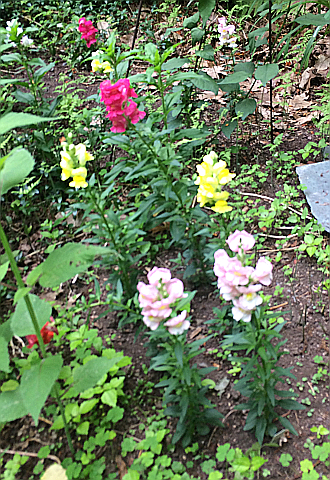
[27 June 2020] The snapdragons are blooming. I planted a dozen, but only eleven are left because I stepped on one when I went to water the impatiens in the French lavage.
Although you can't see it in the picture, the snapdragons are in the middle of a battleground, fought between me and the hill ferns. They are most likely eastern hay-scented ferns, as they have a strong hay-like smell when crushed or pulled. And, since they've been trying to take over the Sunken Garden, I've been pulling them out every week since May. So far, a new crop comes up right away, sometimes growing to about a foot tall in just a week. I like the ferns but they have to stay on the hill and out of the gardens.
The French lavage got a new resident. One of the impatiens there withered away. The other looked like it was going down, but it now looks a bit better. I came across two large impatiens on clearance at a great price, so I'm giving impatiens another chance. (The second new impatiens went into the window box on the garage.)
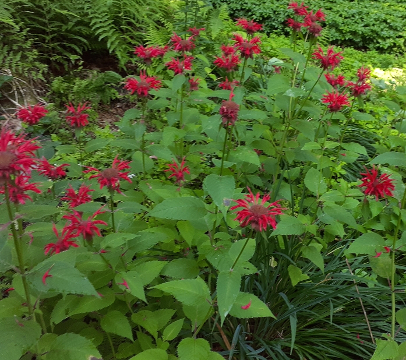
[25 July 2020] Monardas are blooming in the Sunken Garden, where we planted it long ago, and also in the Back Garden, where it jumped there by itself through self-seeding. Monarda is actually the genus name of several species; the red monarda is Monarda didyma (Monarda in honor of Nicolas Monardes, who in the 16th Century wrote books on the medicinal properties of new world plants; didyma is derived from the Greek for "twins" and refers to the fact that the flower's stamens come in pairs). The flower is also know as red (or scarlet) bee balm, and bees do indeed like the flower. So do hummingbirds. Hummingbirds are attracted to bright red flowers, which is why many hummingbird feeders are red. I sat in my three-season porch watching the garden and in about three minutes a ruby-throated hummingbird was buzzing the flowers.
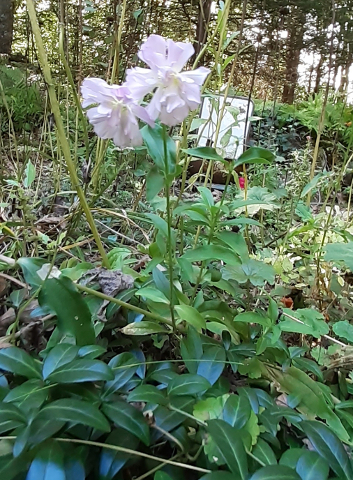
[20 Sept. 2020] Most of my phlox bloomed much earlier in the Back Garden (see double-blossom phlox), but some phlox is blooming now in the Sunken Garden, so here's a picture. That white rectangle in the background next to the blossoms is the
French lavage.
The Hill Garden
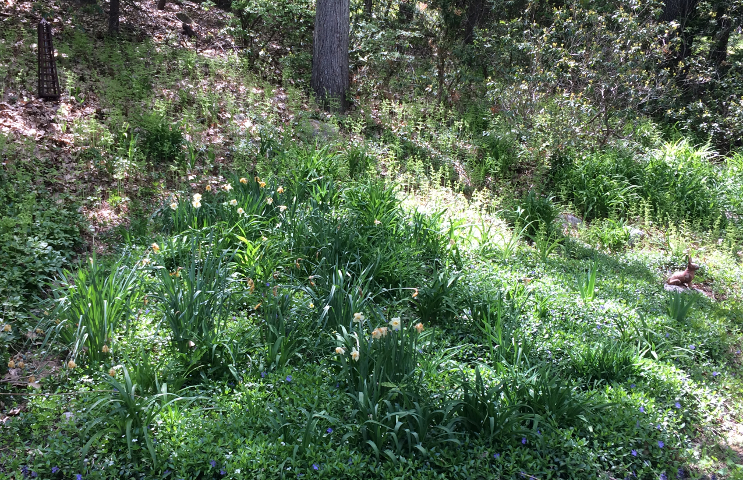
[24 May 2020] The Hill Gard is to the right of the Sunken Garden, separated by a huge patch of Japanese pachysandra, just a little of which can be seen on the left. This whole area was overrun with what we called "sticker bushes" (brambles), invasive vines, saplings, and the like. Over the first few years we slowly cleared out the invaders. We also eventually put a barrier down into the ground to stop the pachysandra from spreading, as it is very aggressive. This mostly works, although every year or two the pach that manages to tunnel under the barrier must be pulled out.
The Hill Garden these days features vinca (Vinca minor or periwinkle). This is a deep-green evergreen groundcover that provides color as soon as the snow melts, quickly followed by blue flowers, some of which are still present in the picture. Next up are daffodils, which again you can see in the picture although many are spent. Fancy hybrid daylilies are third major component and will start to bloom likely in July. There are many varieties with a wide range of colors from pale yellow to deep purple.
There's some other flowers here and there, such as lady's mantle and gooseneck loosestrife. This loosestrife blooms with a cluster of white flowers that suggest a goose's head or neck. The gooseneck loosestrife was originally planted half way up the hill, but it apparently did not like it there and over the years has worked its way all the way down the hill.
Gooseneck Loosestrife (from the internet; the flower is not blooming yet here)
The white-and-rust rabbit on the right is from Brimfield, but, surprise, the "rusty Eiffel Tower" at the top left is not! That came from Tower Hill, the botanical gardens of the Worcester County Horticultural Society. It's about 24-30 inches tall, and some winters it gets completely buried in snow. Alas it was not cheap and is slowly rusting out, unlike everything from Brimfield.
[11 July 2020] Gooseneck loosestrife is finally blooming here. These plants were originally planted about half way up the hill of the Hill Garden, right at the upper boundary where the tended garden transitioned into untended shade plants. Gooseneck loosestrife naturally spreads by growing rhizomes, which are underground stems that then send up new shoots. In moist soil, the plant can spread aggressively, but the Hill Garden is drier, so this loosestrife has only slowly spread down the hill, with the upper and drier stands gradually dying off. It's as if it is seeking moister soil. It's now at the the bottom boundary where the tended garden transitions to mown back yard, so its progress seems blocked. Time will tell if it spreads out laterally along the lower border.
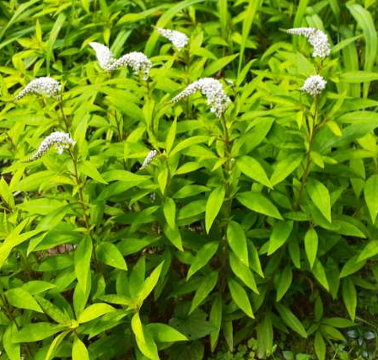
Gooseneck Loosestrife (in my garden)
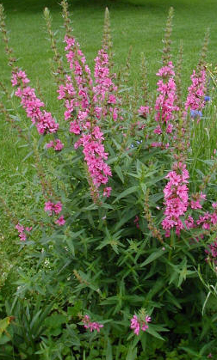
Purple Loosestrife (from the Internet)
Gooseneck loosestrife is not closely related to the rather-dreaded purple loosestrife. The two plants belong to different genuses, both of which have many species called loosestrifes due to their appearance. Purple loosestrife can be a very aggressive plant, especially in wet areas next to ponds and streams, where it can crowd out almost all other plants. While the masses of purple are scenic, the biodiversity of where they invade is greatly reduced, reducing or removing food sources for animals from insects to mammals.
When we moved to Massachusetts, we took frequent canoe trips in central Mass. in the late 1980s and 1990s. It was evident that purple loosestrife was taking over many the wetlands next to bodies of water. However, the threat seems to have abated here. Purple loosestrife is still abundant but I rarely see it in dense mono-species stands. Perhaps some combination of factors are now keeping it in check, like plant diseases, fungus, or bugs munching on it. Whatever is happening, let's hope it spreads to the areas where the wildflower is currently overrunning wetlands.
[18 July 2020] It's now the start of the hybrid daylily season on the Hill Garden.
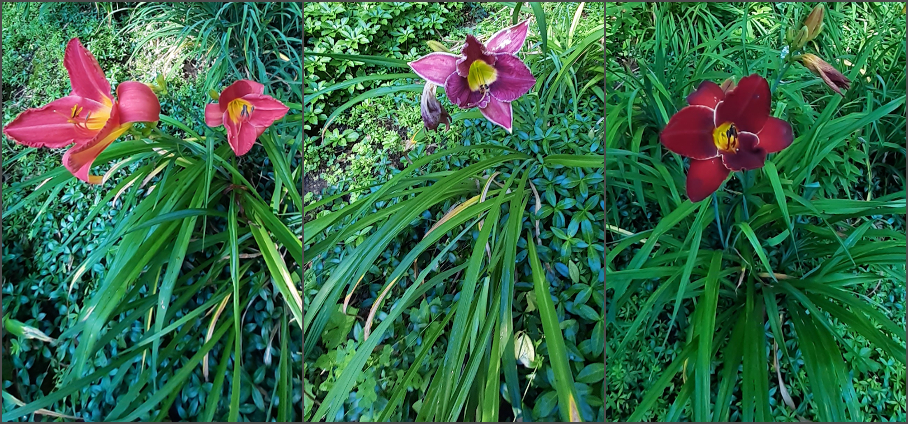
The common orange and yellow daylilies you see in many places are descendants of wild daylilies from Asia that were brought to gardens in Europe and then North America. These are tough plants and can spread over time. If you see patches of them seemingly growing wild, there's a good chance there once was a home or a garden where they are. A good example of this is the Davis Hill Trail at Moore State Park in Paxton, MA. Part of the trail follows a wooded dirt road next to Davis Hill, and daylily patches grow next to the road. These daylilies did not spring up by themselves. Instead, the whole area used to be cleared farmland or pasture land, and the daylilies almost certainly were planted along the road by the farming families who lived there. Most of Davis Hill itself is still farmed for hay, under a conservation restriction (CR) that prevents the land from being developed. The land's owners (or former owners if they donate the land) are allowed to us the land for certain purposes while the public often gains access to it. There's often tax advantages for the owners to enter into a CR.
In the 20th Century, interest in daylilies took off, and a wide variety of hybrid daylilies of many colors and shapes became available. We got many of our hybrids from a couple of Emilie's co-workers when they divided their daylilies as well as from a daylily (and hosta) enthusiast in Bolton or Stow MA who had so many he went into business selling them. However, we also got many from Tranquil Lake Nursery in Rehobath, MA. Tranquil Lake has vast daylily fields with all sort of hybrid daylilies. They also opened our eyes on how tough daylilies are. We had always been so careful to plant a daylily out of its pot while doing the most to leave the soil around its roots undisturbed. When we bought our first Tranquil Lake daylily, which was fully grown, we saw them dig it up from the field and then gently shake all the dirt off the roots! When we asked about that, they told us that daylilies can easily survive this treatment, as long as we plant it in a few days. Just cut the fan of leaves back by about half to reduce the plant's water needs in its new spot. I used this technique to transplant into Emilie's Garden five orange daylilies that were crowding out the arbor, and all five are doing well in their new spots. I hope to move more when the weather cools -- not because the daylilies need cool weather to be transplanted but that I don't want to dig them up in hot, humid weather.
One of Emilie's co-workers was insistent that we not mix hybrid daylilies with common orange or yellow daylilies, or else the hybrids would "lose their color". This puzzled us on how that could happen, but we kept them apart. I finally just today figured out what likely goes on. The hybrids don't lose their color. Instead, the more-vigorous common daylilies outgrow and outspread the hybrids, eventually taking over their space.
[25 July 2020] More varieties of hybrid daylilies are blooming.
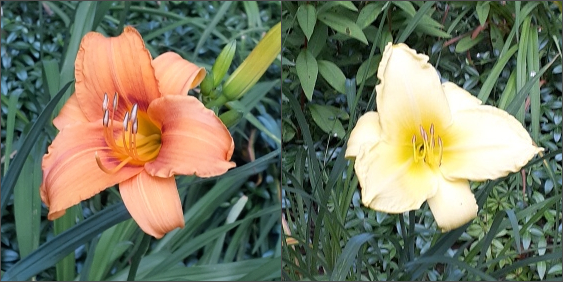
[01 Aug. 2020] More hybrid daylilies are out and about.
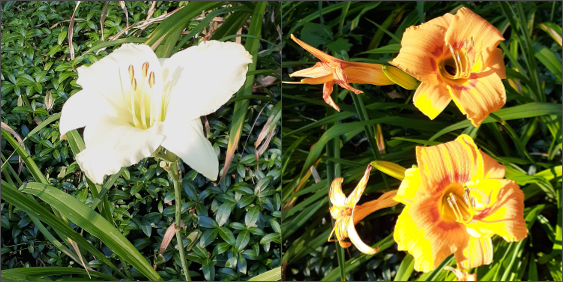
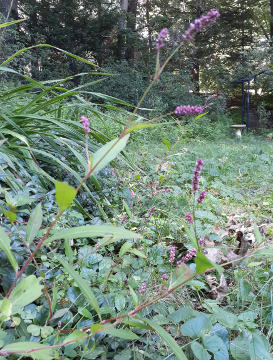
[20 Sept. 2020] I have this wildflower growing in a couple of places in my yard. It is some species of smartweed, most likely lady's thumb, but smartweeds can be difficult to tell apart. The ones by the Hill Garden are short, about 1 foot tall, as they've been mowed over and whacked by a string trimmer at least twice — as you can guess from this, they're tough plants that won't stop growing unless you pull them out*. I've got a stand out front that's much taller, 2-to-3 feet high, and I've seen them even taller in my various walks around here.
Smartweed can be very aggressive and invasive, so people with formal gardens usually try to get rid of it. If it's already established, pulling up the plants* and removing the seed heads before they disperse are the best control measures. I'm not controlling my smartweeds at present and so far they've never been a nuisance and I like how they look.
*OK, in addition to pulling up the plant you can poison the leaves. PLEASE do not use a toxic broadleaf herbicide or any harsh chemical. You can make your own leaf killer with simple household ingredients: Get some white vinegar and mix salt in it until the liquid can't dissolve any more salt. (The Internet will tell you to use "coarse salt", but table salt works just fine.) Add a few drops of dish detergent, put the mixture in a hand-pumped spray bottle, and go spray the leaves when you will have a stretch of several rainless days. The detergent helps the spray to stick to the leaves, and the acidic vinegar and desiccating salt wilt and then kill the leaves. You can see the leaves drooping in a day or two after treatment, and then they turn brown and wither. Since the leaves provide the plant with food, this process can kill the unwanted plant. (A plant with a lot of food stored up in roots might later come back; keep treating it until it gives up.) I found a patch of poison ivy growing in my woods this year. Disposing of poison ivy by pulling it up is laborious and dangerous (the poison ivy oil likes to stick on everything). So, I've used this mixture once on the poison ivy with so far great success.
The Jungle and the Arbor
[30 May 2020] To the right of the hill garden is a daylily jungle backed by a black metal arbor that supports a grape vine. I haven't take a picture yet became the jungle is a huge mass of green leaves while the grape vine hasn't begun growing yet this year. The jungle formerly was where we grew spring peas and summer tomatoes, but it's now too shady for vegetables. We changed over to a few orange daylilies, and they went wild there. The grape vine, a Thompson grape as I recall, does not do too well. We knew it was too shady for grapes where we planted it, as the arbor marks one of the entries to the back woods paths. The poor grape starts late and often gives up early. One or twice it managed to actually grow some grapes!
Canada Anemone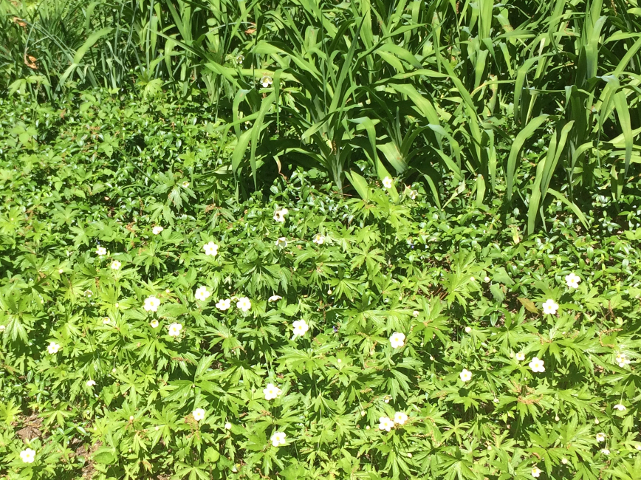
In recent years, Canada anemone has taken over the yard just in front of the jungle. This is a wildflower vine with nice white flowers that just started blooming. I let it have its patch here but mow it down elsewhere as it keeps trying to take over the back yard. The plant spreads by sending out vine runners that quickly root and establish new stands of the plant, so it's very aggressive.
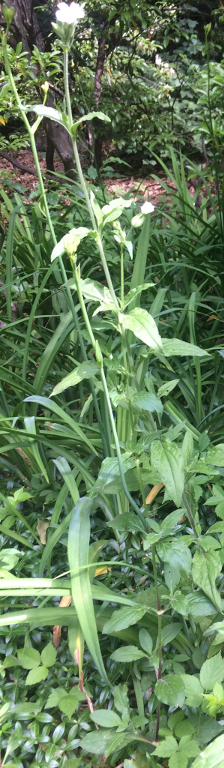
[20 June 2020] White campion is the latest entrant to Wild Bloomapalooza, the on-going wildflower convention in my yard. The plant is also known as bladder campion, as the white flowers grow out of green "bladders" (calyxes, which will hold the seeds), as you can see in the picture. However, "bladder campion" is most often used for a related species, maidenstears. OK, this is a time where the Latin names help. White campion is Silene latifolia alba, "white broad-leaf silene" and maidenstears is Silene vulgaris, "common silene". The silene part comes from Silenus, an often-drunken companion of the Greek wine god Dionysus. However, the only drinking going on around the silenes are insect guzzling their nectar.
There's several more Silene species. Around here, rose campion (Silene coronaria, "crown silene") grows as a wildflower. I have not seen many lately anywhere nearby, although it used to occasionally grow in our yard. The plant has magnificent magenta flowers and is also sold as a garden plant by some nurseries. One year, Emilie and Lisa went to a local nursery and bought several plants. When they got back, they told the story of how Emilie wanted to buy a nice-looking flower, but Lisa thought it was growing in our yard. Emilie bought it anyway, it was a rose campion, and, yes, that year it was growing in our yard. Lisa went home with some nice plants and a good laugh.
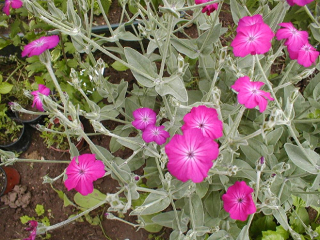
Rose Campion (picture from the Internet)
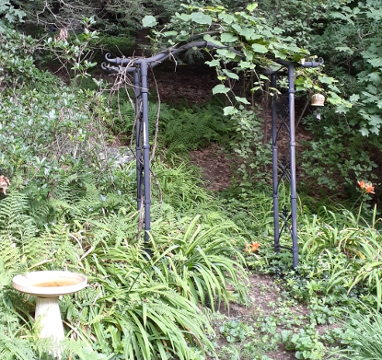
The Grape Vine on the Arbor
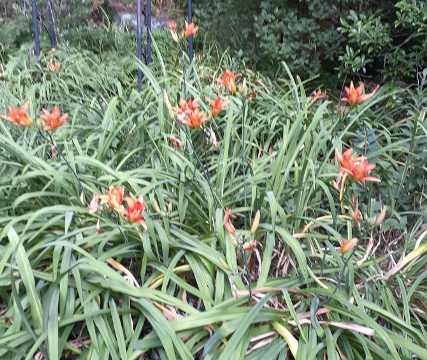
Orange Daylilies in the Jungle
[25 July 2020] The grape vine is having a mediocre year so far. In addition to being in a too-shady spot, it is probably also struggling because of the dry conditions. It's about half the size it would be in a good year. I don't expect any grapes to develop this year.
The orange daylilies vividly show why I call the garden in front of the arbor "the Jungle".
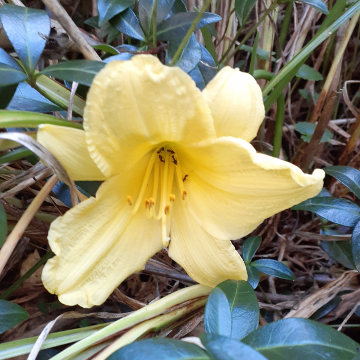
[12 Sept. 2020] Just by chance I happened to look into the mass of leaves lying on the ground in the Jungle and found a stella d'oro in bloom there! It's been weeks since any other daylily has bloomed in my yard, so I'm glad I saw this. (I had a shorter-than-normal daylily season, perhaps because of the drought.) This was a lucky sighting, since a daylily blossom only lasts for one day, and there's no other buds I can see on the stella d'oro.
The Deep Shade Garden
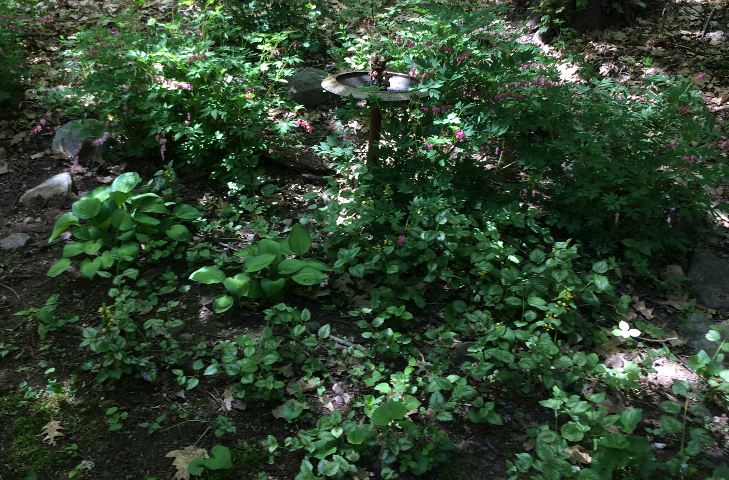
[24 May 2020] This garden is on the right side of the house and is shaded by the trees and the house. Before the leaves come out it gets several hours of sunlight every day, but once the leaves arrive it is lucky to get two hours of sun. Bleeding hearts, lamium, and hosta all grow and flower here. The centerpiece is a cast iron, very heavy birdbath that I might call YABI (yet another Brimfield ironwork). It likes to fall over most winters as the ground under it repeatedly freezes and melts until a small pothole forms, causing the birdbath to topple. In warm weather, rain fills the birdbath's bowl but leaves often fall in and turn a slimy black, likely some chemical reaction involving tannin from the leaves leaching out iron from the birdbath. It's sort of like the evil twin of the Mirror of Galadriel, and you won't like what you see in it. Or, you can just periodically scoop out the leaves and replace the black water with fresh.
Epimediums used to grow extensively just up the hill from the Sunken Garden, but in recent years they've stopped coming up, just like most of the epimediums elsewhere in my woods. Maybe the woods have become a bit too dry for epimediums in recent years, or perhaps epimediums don't last longer than about a decade. You may know epimediums as barrenwort, which you can get in many nurseries, but the vast majority of our epimediums were a collection of different species from China. An epimedium enthusiast lives in Central Massachusetts and made many trips to China to collect specimens for his wooded garden. He had so many that he went into business as Garden Vision Epimediums. For several years, Emilie and I bought these epimediums, and they did great in our woods. Perhaps I will try epimediums again someday.
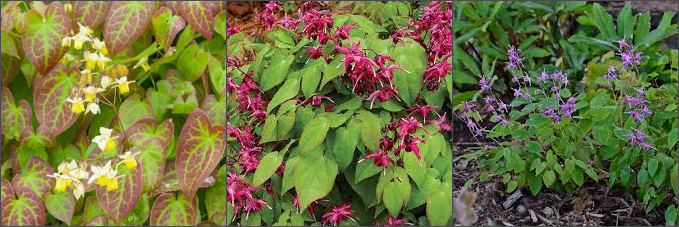
Epimediums (from the internet but representative of some of the epimediums that used to grow in my woods)
[24 May 2020] The Deep Shade Garden turned out to be a great place to grow bleeding hearts. They often grow big here and have begun to spread to other spots. The lamium was never planted here but jumped from the front garden. If you know your lamium, you may suspect this "lamium" is not a true lamium, and you are correct. It's a false lamium, Lamiastrum galeobdolon (lamiastrum means "resembling lamium") but is often called yellow deadnettle, yellow lamium, or just lamium, among other names (some rude, from gardeners who don't want it). It can grow in conditions ranging from full sun to full shade, so some people consider it an invasive intruder, but Emilie and I always liked it. The leaves can range from strikingly variegated to almost all-green, and the flowers are a great yellow.
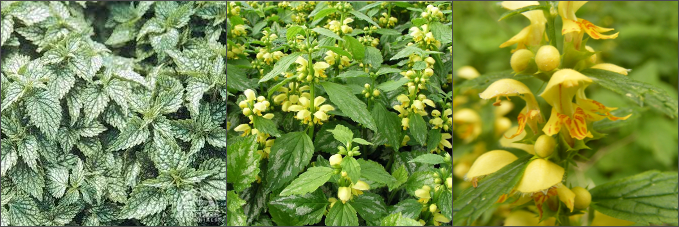
"Lamium" (from the internet but representative of the lamium in my yard)
[24 Oct. 2020] Animal Vandals, or a Story about the Birds and the Bears
A Female Downy Woodpecker at My Home
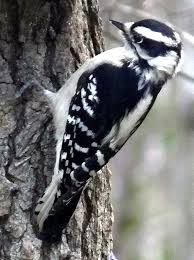
Closeup of a Female Downy Woodpecker (picture from the Internet)
Although I've never seen bears in my year, they occasionally come through at night. Well over ten years ago, in late winter or early spring, one morning all my birdfeeders had been pulled down and the seed taken. It had to be a bear, as one feeder had been hanging from a heavy iron shepherd's hook, which was badly bent out of shape. I tried to bend it back, but the metal wouldn't budge at all. Raccoons couldn't have done that, so it had to be a bear. Vandal!
Woodpeckers also occasionally vandalize my house, pecking holes in the wood siding. If I go bother the woodpecker, it quickly flies away. However, sometimes it comes back right away when I go back in. I've tried hanging foil pie pans on a pole to make noise to scare the woodpeckers away, but this is not particularly effective. I figure the woodpeckers are looking for food, so once they start banging on my house, I put up a suet cake in a cage. That seems to buy off the bird vandals.
This year, the woodpeckers started on the house in early October. Vandals! I put up a suet cake. I suspended the suet cage on two 4-foot-long extension hooks (sort of like giant S hooks) from a high tree limb, which thwarts squirrels and raccoons from getting the suet. A week after the suet cage went up, it disappeared, suet cake, cage, and both hooks. After a search, I found the cage and hooks on the ground under falling leaves. The suet of course was gone. One of the hooks was badly bent. It had to have been a bear that pulled it all down. Vandal!
To be somewhat fair to the bear, it was probably quite hungry. Last year we had a bumper crop of acorns, so bears could gorge in the woods without having to raid the middle of a suburban town. Most people don't know that around here acorns are the number-1 food supply for bears. In fact, until the acorns come in, some bears are still using more energy than they are getting from foraging. In a good acorn year, a bear can almost double its weight during the acorn harvest, which puts it in a great position to survive the winter. In a bad year with very few acorns, a bear gains little weight in the autumn and goes into hibernation in a weakened state.
This year, the acorn crop is slightly meager but not awful — not as bad as I expected given the ongoing drought, but still not great. Also, last year's acorn abundance resulted in a chipmunk population explosion this year, so the chippies are taking a big share of this year's crop. I figure the bears now have to roam around a lot more looking for acorns. One wandered into my yard and scored a cake of suet. I can forgive it taking the suet, but it bent one of my extension hooks. Vandal!
Then it turned out the animal vandals were in a criminal conspiracy. With the suet gone, the woodpeckers began treating my house as a drum again. I needed to put up a new suet cake. However, I found very recent bear scat (with many crushed acorn shells in it) on the driveway, so the bear was coming back at night in hopes of getting more suet. What to do? People who camp in bear territory are told to hang their food container with a rope high over a tree limb, at least six feet from the trunk of the tree. So, that's what I did.
Since then, I haven't had woodpeckers drumming on my house, and I've seen downy woodpeckers on the suet cake (see left picture above). Success!
Into the Woods
[06 June 2020] I have about one and a quarter acres of land, of which perhaps two-thirds is woodland. However, several of the adjoining properties are also wooded like mine, so the actual woods covers perhaps two or three acres. I've built paths through my woods near the boundaries, which helps to delineate my property and stop neighbors from dumping their yard waste in my woods.
Most years, up to a dozen lady's slippers grow in the woods and bloom in June. A dozen is a excellent year; most years there's only two to six (once none at all). I thought this year there would be none, but I found two growing in a brand new place (most grow in the same place year after year).
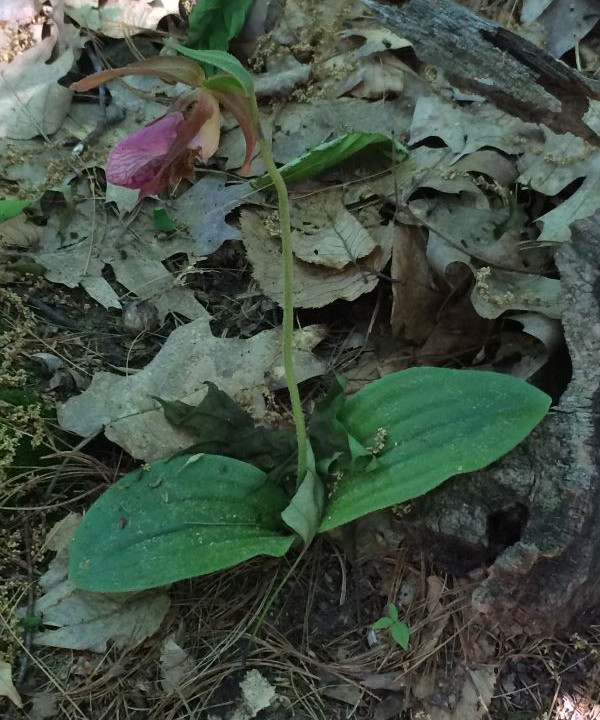
Lady's Slipper
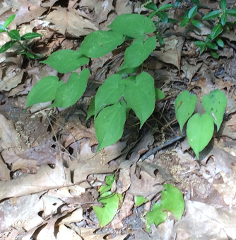
My name is Epimedias,
king of epimediums.
Look on my fate, ye Mighty,
and see yours!
I searched all the places in my woods where epimediums used to grow and only found one, "Epimedias", King of Epimediums. It's only a few inches high and is not blooming (but there's still hope). At the height of its powers, Epimedias was a huge mound of leaves and flowers, up to 18 inches tall and spread over three feet.
All Around the House
new![01 Nov. 2020] OCTOBER SNOW!
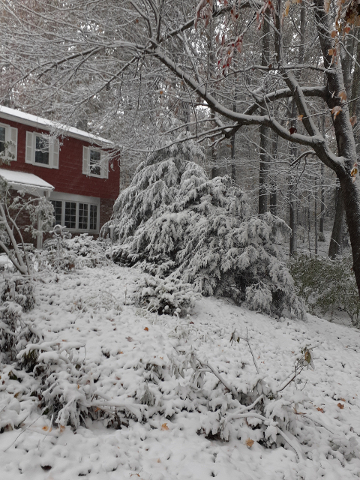
Front of House
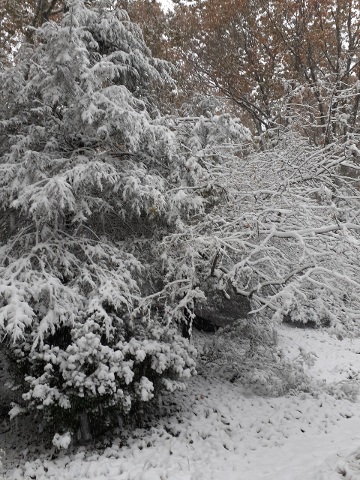
Hemlock and Crabapple in Back Yard
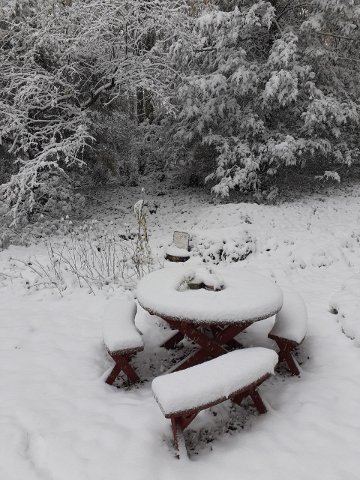
Picnic Table and Sunken Garden
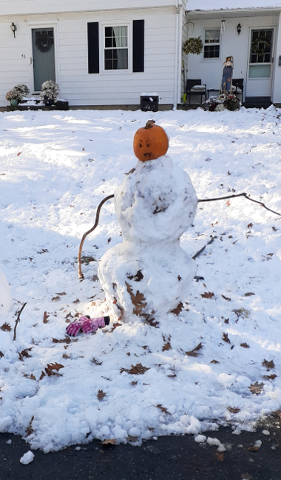
Merry Halloweenmas at a Neighbor's House
It got quite cold (well below freezing) and snowed on 30 October. Holden got 4.5 inches of snow. However, the ground at first was still warm, so about half the snow melted soon after falling. Once the ground chilled, the snow accumulated. The snow stayed throughout 31 October, turning the holiday into Halloweenmas, a cross between Halloween and Christmas. Most of it melted on 1 November, when the afternoon finally got a bit warmer.
Almost all of my remaining flowers got clobbered badly by the snow and cold. The morning glory is all shriveled, and the portulaca, which never quite managed to bloom fully, also gave up. The petunias lost all their blooms but the leaves are still holding up, so we'll see what happens if it gets warmer again.
This amount of snow in October is unusual around here; Massachusetts is not Minnesota or Montana! Still, New England weather can be highly variable. In 2011, a nor'easter around Halloween dumped lots of snow on Massachusetts. Some places only got a couple of inches, but many got lots more. We got 6-8 inches, and some places in the Berkshire Mountains got up to 30 inches. Then, the weather got quite mild, and we had the warmest winter here I've ever seen. The October snowstorm was by far the biggest snowfall storm of the entire winter of 2011/2012!
One year, we had a very mild autumn, without a hard frost until after Thanksgiving in November. That was unusually late for here and solved the giant cosmos mystery. Emilie used to grow cosmos plants from seed, which we planted out back. Almost every year we did this, one of the seedlings developed into a huge plant. The rest of the cosmos were about 2 feet tall, but the giants were easily 6 feet tall or more. The giants' stalks and leaves did look like cosmos, only greatly scaled up. But were they cosmos? They spent so much time growing tall that they never bloomed before the first frost killed them. Until the year the frost came after Thanksgiving. That year, one finally bloomed right after Thanksgiving, and the flower was indeed the same as a regular cosmos. Cosmos are great flowers; maybe I'll try growing them next year.
Inside the House
[20 June 2020] The houseplants, two bougainvillea, two angel-wing begonias, and a Boston fern have gone outside for the warm weather. I should have taken a picture of them before they left the house, as the bougainvillea are hilarious: no leaves but covered in blossoms. When they come back in once the nights get too cool for them, they'll be all leaves and no blossoms! The Boston fern looks a bit scraggly as it slowly shed fronds all winter, but if things go well outside it'll be nice and bushy at the end of summer. I'll take a picture of it if it does.
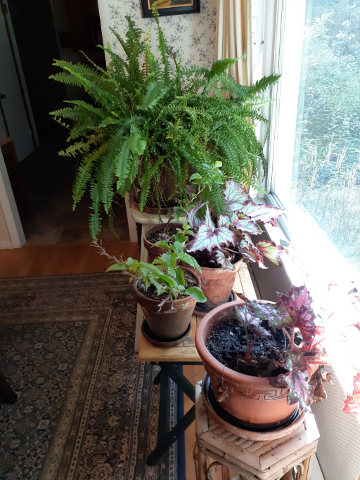
[20 Sept. 2020] The bougainvilleas and angel-wing begonias all came in on the 15th, as the forecast was for a night-time low temperature in the 40s. This is too cold for these tropical plants. The Boston Fern probably should have come it at the same time. However, the forecast also was for days in the 60s and low 70s, temperatures which the fern supposedly really likes. The fern finally came in on the 18th, as the forecast daytime highs were now the upper 50s or low 60s. As you can see the picture, the fern is looking really good. The bougainvilleas are also good, with lots of green leaves (when they went out in June, they had no leaves but lots of pink blossoms).
The weather is supposed to warm up again in a few days, but I doubt I'll put the house plants back out. It's now best to keep the warm inside.
Beyond Gardenwoods
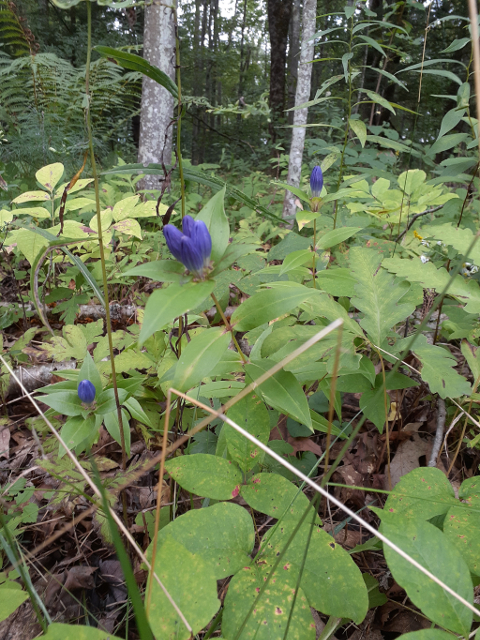
[12 Sept. 2020] I go for many walks and enjoy walking in natural settings. Something nice but a bit odd happened on a recent walk. I got this urge to go to Wachusett Meadows, the Audubon sanctuary in Princeton. It was very cloudy and looked like it might rain, but I went anyway. I climbed up the high meadow maybe thinking I'd go up to the top of Brown Hill, but then I got the urge to walk around the southern part of the sanctuary. As soon as I started on this, I got the sensation that Emilie was walking with me for a couple of minutes. The sun came out soon after. I walked to all the spots we liked to visit.
On the way back, I came to a small pond we always stopped at, and there I saw them: closed gentian.
This flower blooms in later summer and autumn. I had forgotten all about it, but Emilie and I used to go to the sanctuary almost every September to see them once we discovered them one year — they always grow near the pond and nowhere else. The flowers are actually closed, apparently to make it harder for insects to get to the nectar. Bumblebees can pry open the tops of the flowers to get inside.
I finished my walk at the barns, and the sheep were out there, too. This Audubon usually keeps sheep and moves them around the various meadows. Emilie had always loved seeing the sheep; I said hello to them for her. It was a very emotional walk but very comforting too in its way. I'm so glad I got to see the gentian.
[20 Sept. 2020] Update: I've just received and planted closed gentian seeds I bought from Prairie Moon Nursery. Prairie Moon got its start as a prairie restoration project using native plants, later going into business selling the seeds they were producing. As you can guess, this is not your typical commercial nursery or garden center, and they have seeds, bare-root plants, and potted plants for many plants and wildflowers that you won't find almost anywhere else. They not just for Midwestern prairies, either. Their collection covers full sun, partial sun, and shade for all types of soil moistures from dry to wet, for USDA Zones 2 (parts of Alaska and Canada) through 11 (parts of Mexico).
Their seeds come with "Germination Codes" that tell you exactly how to prepare them to best stimulate germination. Check the code before buying seeds, to see what what you need to do. For my gentians, the seeds need to be activated by cold temperatures, Code C(60). So, sowing them now right in the ground is great, as the winter here will wake them up for growth in the spring. At other times of the year, I would have had to make a seed mixture and keep it in the refrigerator ideally for 60 days before planting them. Code A, on the other had, will germinate in a warm location without pre-treatment, so these should be planted in the spring once the weather is warm. I got some Code A seeds that I'll use next year and with luck fill in some shady dry patches under my trees.
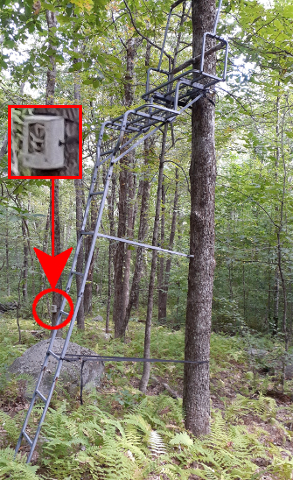
[20 Sept. 2020] I was walking the west loop trail of the Calamint Hill Conservation Area in Princeton this weekend and came up this strange site. Yes, that's a metal ladder attached to a tree. At first I thought the squirrels here were getting particularly lazy, but if so then why didn't they install an elevator instead? My next guess is that it is some kind of temporary observation platform, although there doesn't seem to be anything special to see in the area. Perhaps someone sits on the platform to count the local wildlife like deer? Let's hope not bears, as they can climb, too. Maybe there's something up the tree the ladder gives access to? I did not attempt to climb the ladder; that's an accident in the making if the ladder unstable or poor attached to the tree.
The mystery deepened when I spotted a metal box attached to a tree about a dozen feet from the ladder. My immediate thought was that the box was a geocaching treasure box. (Geocaching is an outdoor activity when you use clues and GPS to find things like treasure boxes or log journals or pictures, or so on. I've seen the occasional geocache site on the rail trails around here, so I know some people geocache in central Massachusetts.) However, it seemed more likely the box had something to do with the ladder. So, I went and examined the box. It was sealed shut with some type of LED light blinking through a window, with a set of what looked like translucent plastic cylinders at the top of the window. I'm guessing it is some sort of scientific sensor, maybe a motion-activated camera to take pictures of wildlife. If so, then they've probably got a couple of me staring into it at close range.
Whatever the ladder and box are, they haven't been visited much. The ferns between the path and both the ladder and box were undisturbed, so no one has walked there recently (except me now).
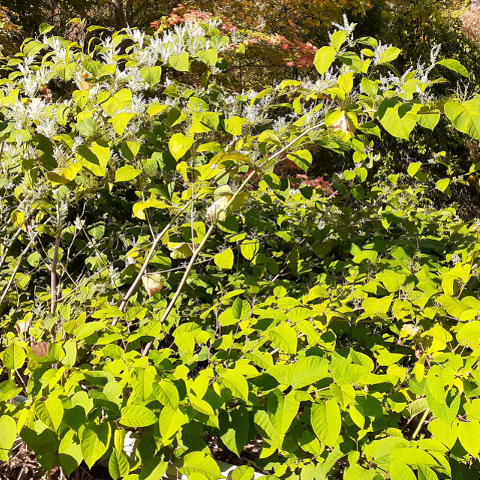
[3 Oct. 2020] I was walking around town in Holden and saw a huge extent of Japanese knotweed at the corner of Main Street and Malden Street. You may know this plant as "Japanese bamboo" because its leaves and stems look like bamboo, but it's not a true bamboo. It looks great (and has small white flowers in season that attract many pollinators), which led to it being imported to North America as a specimen plant in the 19th Century. Alas, it's a very aggressive, spreading plant that most gardeners now don't want in their yards.
There was a patch of it growing alongside our house in Millers Falls when we moved there in 1960. For years, it just grew in the same place in the same clump with no problem. One year, my parents decided to get rid of it. We had no idea how tough it was. I no longer clearly remember why we wanted to get rid of it. I think the knotweed was attracting too many unwanted insects. Millers Falls back then was badly overrun with Japanese beetles every year, and they loved to live on the knotweed. When the plant was in flower, I recall seeing yellow jackets, other wasps, and ants all going for the nectar, in addition to tons of benign honeybees and bumblebees. Yellow jackets were a problem, since they liked to try to nest in our house.
So, the first year we chopped it down to ground level... and again two or three more times when it resprouted. It gave up as autumn got cold. The next couple of years it came up again and again during warm weather, and we chopped it down again and again. At some point, we dug up the roots. Well, as much as the roots as we could get. I remember looking down into a pit four or five feet deep where we had dug them out. It still came back the next year.
One year, its roots grew around to the front of the house and the knotweed came up under the front porch. Yet another year, it grew through the foundation of the house into the cellar! The foundation wasn't poured concrete like you see almost everywhere these days. Instead, the house was old and had, as I recall, fieldstones mortared together. It also had been built with square nails rather than the round "wire nails" that became standard in the 20th Century. The nails suggest the house might have been built in the 1880s or 1890s.
I think we finally got rid of the knotweed by digging a hole and pouring salt water on it. Yes, I've read that knotweed is very resistant to salt water, but perhaps after years of being cut down and dug up, the roots just didn't have enough food left to go on. (The leaves make sugar for the plant, which the roots store up for bad times, so if you keep cutting the plant down its food supply has to diminish.) Maybe we used an herbicide, but this seems less likely since children played in the yard almost everyday from early spring to late fall.
Happy ending? Well... not quite. When we chopped down the stems and leaves, we dumped them in the empty wooded lot across the street. Apparently the cuttings took root and established themselves on the sunny margins of the lot. Forty years later in the 2000s I was driving by the area on my way to Shelburne Falls or maybe southern Vermont. I swung though the village and the wooded lot was still undeveloped and fully edged with masses of Japanese knotweed. Tough plant; be careful if you decide to make friends with it. It doesn't play nice.
A Walk at Stillwater Farm
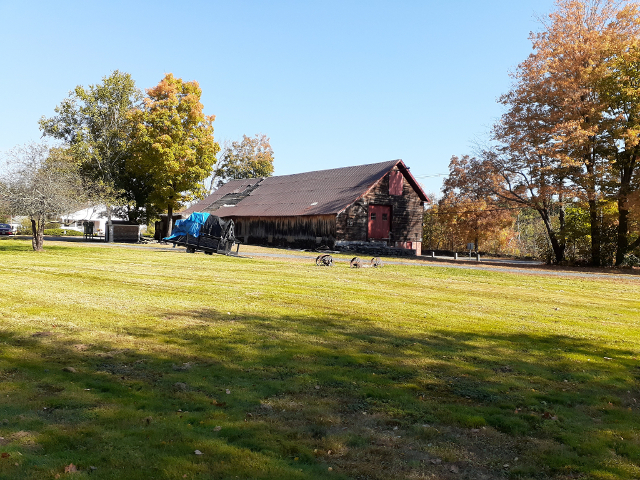
The Barn at Stillwater Farm, Built 1868
[3 Oct. 2020] Stillwater Farm in Sterling MA is now conservation land, but it was a working farm from about 1790 to the early 1970s. Its property originally extended in a narrow but long lot from the Stillwater River to farm fields and then up an increasingly steep hill. This was a fairly common farming arrangement in parts of pre-industrial New England*. You might expect a farm would want to concentrate on the most farmable land, but the river-field-hill arrangement provided many benefits in an era without motorized farm equipment, electricity, or railroads. The river could be used as a source of water, and the flood plain could be used as a wet meadow for growing hay. (It's unclear from the present site if Stillwater Farm had a wet meadow, since there're now roads, a bridge, and a containment pond where the wet meadow would have been.) Above the wet meadow were the farmhouse, farm buildings, and farm fields where the main crops were grown.
*The Willard Farm site at Fruitlands Museum in Harvard MA is another example of this farming layout. The site has an excellent explanation of the farm and layout and is well worth a visit. The museums and rest of Fruitlands are also worth seeing. Fruitlands was an 1834 "Transcendentalist experiment in subsistence farming and Emersonian self-reliance". As you might guess from the quote it was an idealistic but unrealistic community that didn't last long (only a few months). In present times, Fruitlands Museuem now features an art museum, a Native American museum, a Shaker musuem, and a 19th Century farmhouse.
Going uphill, Stillwater Farm had an apple orchard in the west, now long gone. If you've seen New England apple orchards, you might have noticed that some, if not many, are on the lower slopes of hills. This is not just because much of New England is hilly. Instead, it was a natural way to protect the trees. Massachusetts is now on average 2 degrees F warmer than it was a century ago (see this chart) and could have quite chilly weather and frosts in October during the apple harvest. Frosts could damage the harvest, but planting apples trees on slopes with well-drained soils meant that the frost would melt sooner in the day and drain away.
Much of the rest of the hill was pasture for the farm animals. It's unclear if Stillwater Farm itself pastured many sheep, but it seems likley. Very many New England farms had sheep, as their wool was an important source of income. (Many New England farms failed or were abandoned when wool prices collapsed in the late 1800s. In recent decades, sheep have made a minor comeback in New England, due to the development of a sheep-milk dairy industry.) Even with long-abandoned farms, you can usually easily tell the difference between crop fields and pastures. The fields have no stones in them, while pastures often have plenty of stones or ledge. Unlike plows, sheep weren't bothered by stones.
One last part of the hill was the woodlot, the area left for trees, possibly for lumbering and especially for firewood. Traditional New England farms ran on firewood, not only for heating and cooking but also for any heat processing of agricultural products. Even today you can find a few New England "sugar houses" that still use firewood to boil down maple sap into syrup and sugar. Trees took a beating in New England. Pre-colonial New England was mostly wooded, up to 80% of the land. The colonist farmers cleared the trees to plant their crops. They used wood to fence in their livestock and their land. They used wood to build their houses, barns, furniture, parts or all of tools, toys, and so on. They burnt a lot of wood for heating and cooking. At the height of traditional New England farming, only about 20% of the land remained wooded. (Now, about 70% is wooded, despite, for example, Massachusetts' population more than doubling since 1900 with extensive suburban sprawl caused by automobiles and paved roads.)
This river-field-hill layout meant that the farm was diversified: hay from wet meadows, crops from the fields, livestock in the pastures, apples from the orchards, firewood from the forest. This made the farm grealy self-sufficient, often with a surplus of agricultural product to sell. Profits could be use to buy necessities that the farm did not produce (iron tools, for example) as well as the occasional luxury. In bad years, this diversity meant that maybe some part of the farm remained productive even if another part was not. (In 1816, the "year without a summer" caused by cooling from a volcanic eruption, almost everyone suffered.)
A Stone Wall at Stillwater Farm, Abandoned Farm Equipment in the Background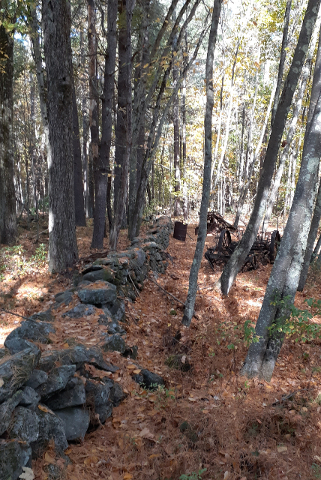
New England is famous for its old stone walls. You can often see them in fields and in the woods. You may have been told that the early colonists builts the walls to remove the many rocks from their fields. Not so! The stone walls were built later, replacing the wooden fences the farmers had previous used. Many were built in the late 1700s and early 1800s. And, the stone walls were usually not built through the woods. Instead, they were erected in cleared land, to mark boundaries, enclose fields and pastures, and to pen livestock. As farms were abandoned, trees naturally regrew on the land, so that now you can often find stone walls in middle of the woods.
And farms were abandoned left and right. Most (not all) farming in New England fell on hard times in the latter decades of the 19th Century. By then, more-productive farms were spreading throughout the Midwest. The rise of railroads meant that cheaper farm staples could be brought to New England. Wool prices declined, making raising sheep unprofitable. Most New England farmers couldn't sell their farms, since few people wanted to buy an unprofitable farm. So, many simply abandoned their farms, either moving out west to start again or moving into the mill towns to work in the factories.
Another way to cope with the poor farming situation was to cut back and linger on. At Stillwater Farm, a lot of pasture land was left to grow trees (likely because the farm's livestock was reduced in numbers). At some point, the apple orchard ceased to be maintained. Finally, the farm was converted to a dairy farm. In the early 1970s, even the dairy farm was no longer viable, and the farm was finally abandoned. In 1990, the state of Massachusetts acquired the land for conservational and educational purposes.
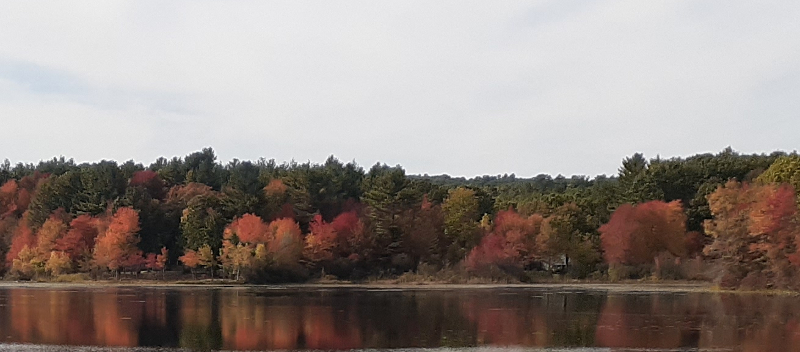
[10 Oct. 2020] As often occurs around here, the maples are showing good color in this second week of October. The picture shows a view across Dawson Pond in Holden. The colors are a little less vibrant than usual, with fewer reds and more oranges and yellows. This is likely due to the drought. Maples naturally have yellow and orange leaves, but during the growing season the leaves are green because of their huge amounts of chlorophyll, which the leaves use to harvest energy from sunlight to make the sugars that feed the entire tree. As autumn begins, the chlorophyll breaks downs, and the green color goes away.
Under usual conditions, this process happens when the nights are getting cold, and the stress of cold triggers another process in the leaves: leaf sugars are turned into anthocyanin, which is red. If a lot of anthocyanin gets made, the leaves will appear brilliant red. (Many other plants also make anthocyanin; the skins of red, ripe apples are red from anthocyanin.) If only a little anthocyanin is made, the natural yellows and oranges of the leaves are seen instead. Burgundy-colored leaves can occur when red anthocyanin and green chlorophyll are both present in some quantity. (Dead leaves turn brown as all the leaf pigments break down.)
Why do some maples make all this anthocyanin? Since anthocyanin is made from sugar, wouldn't it be better for the maple just to pull all that sugar into the roots for next spring's food supply? After all, willow leaves just go yellow without flooding themselves with anthocyanin, so anthocyanin obviously isn't vital for all trees. Alas, nobody knows for sure why maples are crazy about having anthocyanin in their autumn leaves. This has been an active area of scientific research for decades. There's several theories about maples and anthocyanin but so far no convincing proof. Some theories posit anthocyanin gives a positive benefit to maples (such as more strongly attaching the leaf to the twig so that the leaf falls off later and more of the remaining leaf sugars can be sent to the roots, or the red helps protect the final productive stages of the leaves in some way maybe like sunblock, or the brilliant red deters some kind of insect pest to go attack less-colorful maples). Other theories posit that the red used to have a benefit but doesn't any more (such as once deterring some insect pest which is now extinct). Yet other theories posit there isn't and wasn't any benefit (such as anthocyanin just being a unneeded byproduct of some other necessary process in maple leaves). I personally find it intriguing that red maple leaves tend to stay on the tree longer than yellow or orange ones, but I'm still waiting for strong evidence that this actually confers some advantage.
In years with abnormal conditions, maples make less, sometimes much less, anthocyanin. Drought can cause this, and around here we have been in stage D2 "severe drought" for months. It seems likely to me that the maples weren't making enough sugar for all their needs and the roots were getting the lion's share to enable the trees to survive to the next growing season. Little then is left in the leaves to make anthocyanin, resulting in duller autumn colors.
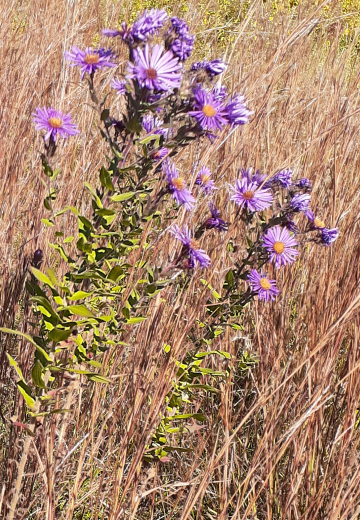
[10 Oct. 2020] I was hiking the trails in the southwestern side of Wachusett Reservoir and saw these brilliant purple asters with yellow centers. Although there are several species of asters that look like this, I think these are New England asters.
Wachusett Reservoir is a large reservoir mostly surrounded by conservation land, so it has many hiking trails. When the reservoir was first filled in 1908, it became the world's largest reservoir for public water supply, eventually covering almost 7 square miles containing 65 billion gallons of water. It was later dwarfed by the Quabbin Reservoir, which began filling in 1939 and came to cover almost 39 square miles with 412 billion gallons of water. Four entire small towns in Massachusetts were taken over by the state and dismantled to make way for the Quabbin. In contrast, the Wachusett only flooded parts of four towns, although hundreds of homes, factories, business, and other structures were demolished. However, this makes Wachusett's negative impact on the local population seem much less than the Quabbin's. Actually, 2,000 people (see page 37 in "The Search for Water") were displaced for the Wachuesett Reservoir, only a few hundred less than the 2,700 displaced for the Quabbin.
Map Showing the Locations of the Wachusett and Quabbin Reservoirs
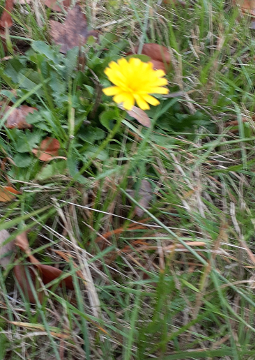
[17 Oct. 2020] I finally spotted some yellow hawkweed wildflowers out by the Wachusett Reservoir. The flower might look like a dandelion on a quick glance, but it is actually an entirely different kind of plant. There are many species of yellow hawkweed, so it can be difficult to identify exactly which one it is. This year, all the hawkweeds I saw there looked stunted (probably because of the drought), so I didn't even try to pin down the species.
In a normal year, I can find yellow hawkweed growing all over town and sometimes in my yard, but I've seen none at all in Holden this year. The only reason for their absence must be the drought.
There's also orange hawkweed, which is a vivid orange color and is sometimes evocatively called devil's paintbrush. Around here the orange variety is rarer than the yellow. Some but not all years I can find it in Holden, usually growing along Phillips Road in the center of Holden for some reason. I've never had any come up in my yard.
Emilie and I first saw devil's paintbrush on a summer camping trip to Baxter State Park in Maine. We went to climb Doubletop Mountain, a mountain with two separate peaks, and saw a large field chock full of devil's paintbrush.
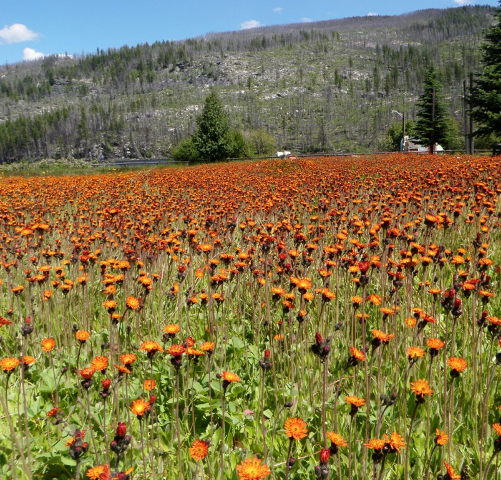
A Field of Devil's Paintbrush (from the Internet; not at Baxter State Park)
newest![08 Nov. 2020] Beavers at Muddy Pond
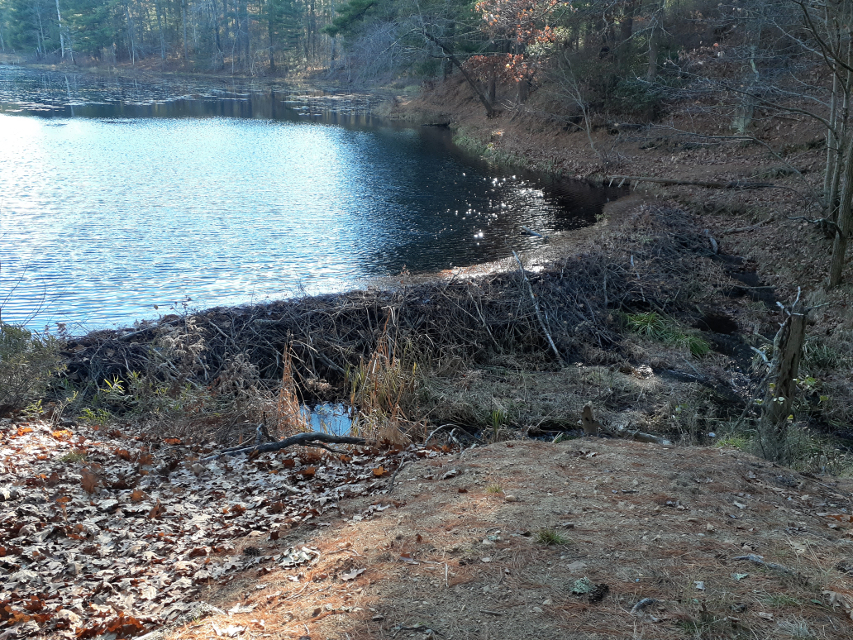
Beaver Dam at Muddy Pond
This is a quite large beaver dam, at least 30 feet wide and up to five feet high in places. The height of the dam means there is a fair amount of water pressure on it. The beavers must be actively maintaining the dam constantly, otherwise it'd breach. One year they did not maintain the dam and it quickly fell apart, but a couple of years later they rebuilt it again.
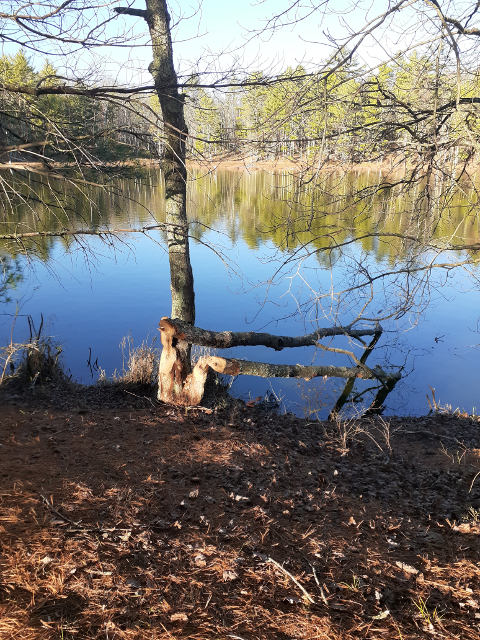
Gnawed Trees at Muddy Pond
Beavers will gnawed on most trees along the ponds and streams where they are living. They won't touch pine trees but almost everything else is fair game. They'll take down anything from bushes and saplings to large trees with trunks over 18 inches in diameter. They typically use part of the tree for food and much of it for their dams. They actually don't have a dam at this pond, as it is a section of Muddy Pond that has been cut off by a railway causeway (now part of the hiking trail). A culvert must connect it to the main body of Muddy Pond, as it does not appear to have any streams flowing into or out of it. There's actually a beaver lodge on the other side of the pond, but it's hard to see in the photo: it's the darker brownish smudge along the far shore near the center of the picture.
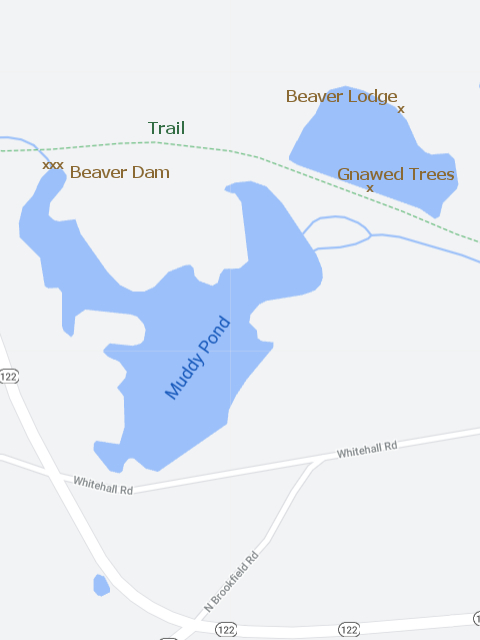
Map of Muddy Pond
When I was a child in rural western Massachusetts in the 1960s, I never saw any signs that beavers were around. Beavers had disappeared in Massachusetts by 1750, not just because of overhunting but also because of the clearing of the forests, the beavers' habitat. The woods were cleared for agriculture and pasture. In the second half of the 19th Century, economic factors made it difficult or impossible for most Massachusetts farmers to make a living, and farms began to be abandoned. The forest regrew over time, and in 1928 beavers were seen living in Massachusetts (in Stockton, extreme western Massachusetts) for the first time since 1750. However, it must have taken them a long time to grow their population and expand their range, as I never saw any in the 1960s despite living in an extensively forested region (Franklin County).
I moved to the Midwest in the 1970s but returned to Massachusetts (central Mass.) in the late 1980s. Now, beavers are common throughout much of the forested parts of the state. I frequently see signs of beavers on my walks near streams and ponds: gnawed down trees, dams, and beaver lodges. The pictures above are from the Muddy Pond on the Central Massachusetts Rail Trail, near the border between western Rutland and northern Oakham. This region is almost ideal for beavers, with plenty of streams and ponds. At times, I've seen six or seven actively maintained dams along the trail. Currently, only two are being maintained. I haven't seen the beavers themselves here, as they are mostly active at night, although I've occasionally seen some during the day at another place on the trail and at Wachusett Meadow Wildlife Sanctuary in Princeton.